Thanks Bill Greenwood!
Tue Jul 31, 2007 2:21 pm
Just wanted to thank Bill Greenwood for taking time out of his busy schedule last week at Oshkosh to take my son up in his Spitfire. (He's still wearing the smile.) As many of you already know, Bill is a real gentleman and it was a pleasure to finally meet.
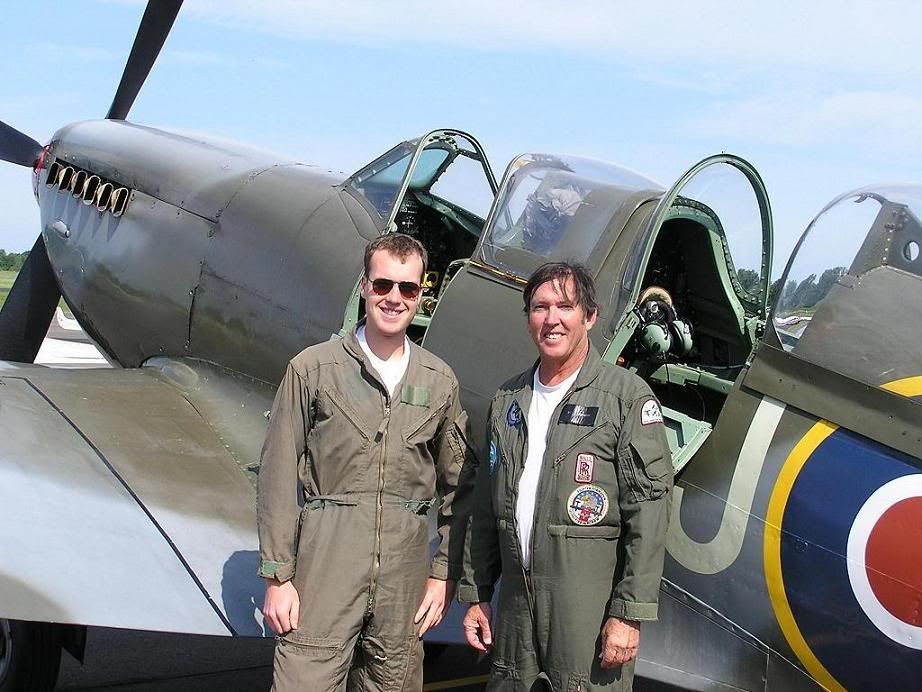
Now if I could only lose about 35 lbs.....
Jim
Now if I could only lose about 35 lbs.....
Jim
Tue Jul 31, 2007 2:27 pm
Gee thanks a lot Jim  ...you just had to rub it in didn't you!
 (sorry...it's the jealousy coming out in me
  ).
).
John
...you just had to rub it in didn't you! (sorry...it's the jealousy coming out in me ).
John
Tue Jul 31, 2007 3:46 pm
Where's the line form?
Bill, BTW one thing I was thinking, When Douglas Bader flew Spits, how the heck did he actuate the brakes. I would think on landing, with that short coupled gear, the brakes would be needed, and DB's prosthetics would have some trouble working them. Maybe he just willed the aircraft down the runway. An amazing man and pilot.
Bill, BTW one thing I was thinking, When Douglas Bader flew Spits, how the heck did he actuate the brakes. I would think on landing, with that short coupled gear, the brakes would be needed, and DB's prosthetics would have some trouble working them. Maybe he just willed the aircraft down the runway. An amazing man and pilot.
Tue Jul 31, 2007 5:20 pm
oscardeuce wrote:Where's the line form?
Bill, BTW one thing I was thinking, When Douglas Bader flew Spits, how the heck did he actuate the brakes. I would think on landing, with that short coupled gear, the brakes would be needed, and DB's prosthetics would have some trouble working them. Maybe he just willed the aircraft down the runway. An amazing man and pilot.
I am really rusty on Spits... but I seem to recall back when I was young and helping on the Spitfire restoration at Geneseo, that the brakes were controlled by a contraption that looks like a bicycle handle brake on the spade grip? The rudder pedals were just for the rudders and the brakes were dependent on which side the spade grip was thrown...
I could TOTALLY be wrong though... please, someone more knowledgeable contribute here

Tue Jul 31, 2007 5:27 pm
oscardeuce wrote:Where's the line form?
Bill, BTW one thing I was thinking, When Douglas Bader flew Spits, how the heck did he actuate the brakes. I would think on landing, with that short coupled gear, the brakes would be needed, and DB's prosthetics would have some trouble working them. Maybe he just willed the aircraft down the runway. An amazing man and pilot.
Funny you should mention that. On yesterday's desk calendar (Golden Age of Flight), there's a beautiful rear view of a Spitfire. The comment below said "American pilots also have trouble adjusting to the Spitfire's braking system, which differs so radically from U.S. practice." If you don't mind answering Bill... or anyone else in the know for that matter... what do they mean?
Air brakes
Tue Jul 31, 2007 5:52 pm
Re. air brakes like a Spitfire, Hurricane, etc. are very simple to use, as a matter of fact I prefer them to the US system of toe brakes that are hydraulic. Air brakes are controlled by a lever on the control column that looks like a clutch lever on a motorcycle. Remember Spitfire rudders are pretty effective and brakes aren't really needed for most of the landing roll out. Let's say you are taxiing and want to turn, first you push the rudder pedal, just as in most planes, then if you want more you squeeze the brake lever and it sends air pressure to the wheel on the side that the rudder pedal is deflected. At speeds above about 30 mph you would not normally need brakes for directional control. When you want to stop in a straight line, just keep the pedals even and the brake lever sends the same amount of air to each wheel. The only real disadvantage is that air pressure can leak from the tank when parked and the engine driven compressor is not running.
Tue Jul 31, 2007 5:53 pm
oscardeuce wrote:Where's the line form?
When Douglas Bader flew Spits, how the heck did he actuate the brakes. I would think on landing, with that short coupled gear, the brakes would be needed, and DB's prosthetics would have some trouble working them. Maybe he just willed the aircraft down the runway. An amazing man and pilot.
Unfortunately, I am extremely well qualified to answer this question, as I have exactly identical amputations to Bader (right above knee, left below knee), also due to an aerobatics-related crash.
The reason he could fly is that Spits, and nearly all Britsh aircraft of that area (as well as all Eastern European aircraft, past and present), have air-operated brakes as opposed to hydraulic brakes.
The air brakes are generally operated by a lever on the stick that looks just like a bike brake lever. A valve attached to the pivot point of the rudder bar modulates the air to each brake cylinder. If the pedals are neutralized, and you squeeze the brake handle, air is distributed evenly to each wheel cylinder, and thus you will even even braking on each wheel. If you are applying full right rudder, and squeeze the brake handle, you get full right brake and no left brake.
I have flown of number of aircraft with this set-up, including Yaks, and an L-39, and it is no problem for me to safely operate the aircraft in all phases of flight. (The bigger problem is usually climbing in to the cockpit).
Some aircraft, such as a Chipmunk, and early Stinsons, have hydraulic brakes operated in a similar manner, except that instead of the brake grip on the stick, they have a handle by your side that you lift to generate the hydraulic pressure. While the air brakes on the stick set-up is super easy once you get used to it, the hydraulic style set-up is less than optimal since you have to "dedicate" a hand to the brake handle.
For the tech geeks out there, there is a recent above-knee prosthetic called the C-leg that you can program (with a laptop) to help work toe brakes. There is actually an above-knee amputee Lt. Col in the Air Force (and a good friend of mine) who flies Gulfstreams out of Andrews with this set-up. I also have this leg and occasionally fly a King Air 350 with it without too much problem. In fact, the bigger problem is getting enough leverage with my above-knee leg to push the right rudder in tight, full deflection turns on the ground...sometimes I have to use my hand to push down on the knee to get enough force.
Being a below-knee amputee isn't a big deal (all relative, of course) as you still have all the strength of your knee, and you can just "lift" your "foot" up onto the toe brakes. There have been a number of famous pilots, including the Stuka legend Hans Ulrich Rudel, who have flown with below-knee amputations.
ride
Tue Jul 31, 2007 10:46 pm
It was my pleasure to meet you guys and fly with Tom, and I hope he is able to pursue his Air Force career. He adapted very quickly to flying the Spitfire. I think you ought to buy him one and I'll help him fly it. How about a nice MK V,or a Griffon one?
Tue Jul 31, 2007 11:00 pm
Just an extra little piece of information for anyone who is interested. I don't know if it is the same setup (ie: air brakes) but the brakes on the Avro Lancaster are activated using the control column rather than toe brakes. I don't know about any of the other Heavies, but I was impressed/surprised when I first heard this.
Wed Aug 01, 2007 2:29 pm
Thanks Bill... Db2 and Greg. Thsi place is always a wealth of information 
Introduction
Wed Aug 01, 2007 11:53 pm
Fellow WIXer's,
This was my first post and one thing I failed to do was to introduce myself. My name is Jim Tradup, live near St. Paul, MN and have been a private pilot for over 10 years. I've followed the WIX site for quite some time because of the wealth of information available, but never posted until now.
My son Tom (in the photo with Bill Greenwood) has been my "co-pilot" and recently got his own ticket. He's currenty a senior at the University of North Dakota in the Air Force ROTC program and hopes to get a flighter slot. I thought it would be neat to arrange a flight with Bill this year at Oshkosh as this might be his last one for a while. (He's attended every year since 1990.)
If you're asking, "Why did he get a Spitfire ride before me?" Easy answer, he fit.....I didn't.
Thanks again Bill,
Jim
This was my first post and one thing I failed to do was to introduce myself. My name is Jim Tradup, live near St. Paul, MN and have been a private pilot for over 10 years. I've followed the WIX site for quite some time because of the wealth of information available, but never posted until now.
My son Tom (in the photo with Bill Greenwood) has been my "co-pilot" and recently got his own ticket. He's currenty a senior at the University of North Dakota in the Air Force ROTC program and hopes to get a flighter slot. I thought it would be neat to arrange a flight with Bill this year at Oshkosh as this might be his last one for a while. (He's attended every year since 1990.)
If you're asking, "Why did he get a Spitfire ride before me?" Easy answer, he fit.....I didn't.
Thanks again Bill,
Jim