aerial japanese pearl harbor bombs made from naval shells??
Wed Feb 27, 2008 10:25 pm
i'm watching secrets of pearl harbor on the military channel, it states that the japanese aerial bombs used on december 7th 1941 were fashioned from naval battleship shells with stabilizing fins that were adapted due to metal shortages in japan. while an interesting theory, you cannot put stock into everything found on the internet / google / tv documentaries as i try to tell my kids in school in regard to their homework. but.......... i don't know everything!! is this true??
Wed Feb 27, 2008 10:32 pm
They did use naval shells, but they used them because they would get better penetration then general purpose bombs.
Wed Feb 27, 2008 10:34 pm
I think i read that in John Tolands The Rising Sun: The Decline and Fall of the Japanese Empire 1936-1945, I could look it up.........
Wed Feb 27, 2008 10:44 pm
They also said the japanese wanted to sink the Battleships, thier goal was the aircraft carriers that had left Pearl days before the attack. If they had been there the war might have lasted longer.
????
Wed Feb 27, 2008 11:32 pm
I beleive the USS Arizona was hit by a naval shell 
Thu Feb 28, 2008 1:00 am
Traditionally the credit for the shell bombs' design has been given to Petty Officer Noboru Kanai, a Kate bombardier who flew off the Soryu during the attack at Pearl. Kanai-san's bomb is apparently the one that set off the Arizona's magazine.
Thu Feb 28, 2008 1:41 am
www.freerepublic.com/focus/f-news/1433239/posts
I borrowed a copy of the now out-of-print book "Descent Into Darkness" from the local library. The author speaks of two aerial bombs discovered during salvage operations on the Arizona which were converted coastal defence artillery shells. These shells were actually American made and had been sold to the Japanese as scrap iron years earlier. In Chapter IV under the heading "Ben finds a bomb", the author describes the projectile in this fashion;
"It was a fifteen inch shell that at one time had been used by old U.S. coastal guns, long since obsolete. The U.S. imprint was clearly visible stamped into the base of the shell. Stabilizing fins had been welded into its base in order to give it the charachteristics of a spiraling bomb."
I borrowed a copy of the now out-of-print book "Descent Into Darkness" from the local library. The author speaks of two aerial bombs discovered during salvage operations on the Arizona which were converted coastal defence artillery shells. These shells were actually American made and had been sold to the Japanese as scrap iron years earlier. In Chapter IV under the heading "Ben finds a bomb", the author describes the projectile in this fashion;
"It was a fifteen inch shell that at one time had been used by old U.S. coastal guns, long since obsolete. The U.S. imprint was clearly visible stamped into the base of the shell. Stabilizing fins had been welded into its base in order to give it the charachteristics of a spiraling bomb."
Thu Feb 28, 2008 8:23 am
Dan K wrote:Traditionally the credit for the shell bombs' design has been given to Petty Officer Noboru Kanai, a Kate bombardier who flew off the Soryu during the attack at Pearl. Kanai-san's bomb is apparently the one that set off the Arizona's magazine.
Hi Dan,
The "Kanai Tradition" for the BOMBING of the USS Arizona (not the design of the bomb) began -and ended- with Dr Gordon Prange in his TORA! TORA! TORA! (Tokyo: Reader's Digest; 1966) and was not corrected for his English version of that book titled AT DAWN WE SLEPT (NY: MacMillian, 1981).
In 1967, the Japanese War History Office released SENSHI SOSHO: HA-WA-I SAKUSEN...their official history of the Pearl Harbor Attack. Thus, Prange found MANY errors in his TORA volume, among which is the credit to Kanai for the destruction of the USS Arizona. He began his changes for his English version of his book and completed the 'cause' and 'effect' sections before his death in 1980.
The tactical section of AT DAWN WE SLEPT stinks.
The high-level bombs were dropped in groups of five (one bomb per KATE). You may read a bit about this in BATTLESHIP ARIZONA by Paul Stillwell (Annapolis; USNI; 1989) by checking the index for John DeVirgilio and my name. The five B5N2 from the HIRYU led by Tadashi KUSUMI hit the Arizona and the repair ship Vestal -one bomb of the five hit each ship. The trained bombardier for the five planes was Shomatsu KOBAYASHI, in the #2 aircraft, the other four bombardiers only toggled their bomb release. Read more of this in John DeVirgilio's "Seven Seconds to Infamy" Naval Institute Proceedings, Dec 1997.
The special bomb used at Pearl Harbor, was a "16 inch" naval artillery shell which had been turned on a lathe to an aerodynamic shape with added fins. Alas, for Japan, this weapon failed to do its job. Except for the fluke of destroying the Arizona, that weapon failed in all other drops. Japan never used this weapon again.
Hope this helps,
David Aiken
Thu Feb 28, 2008 8:43 am
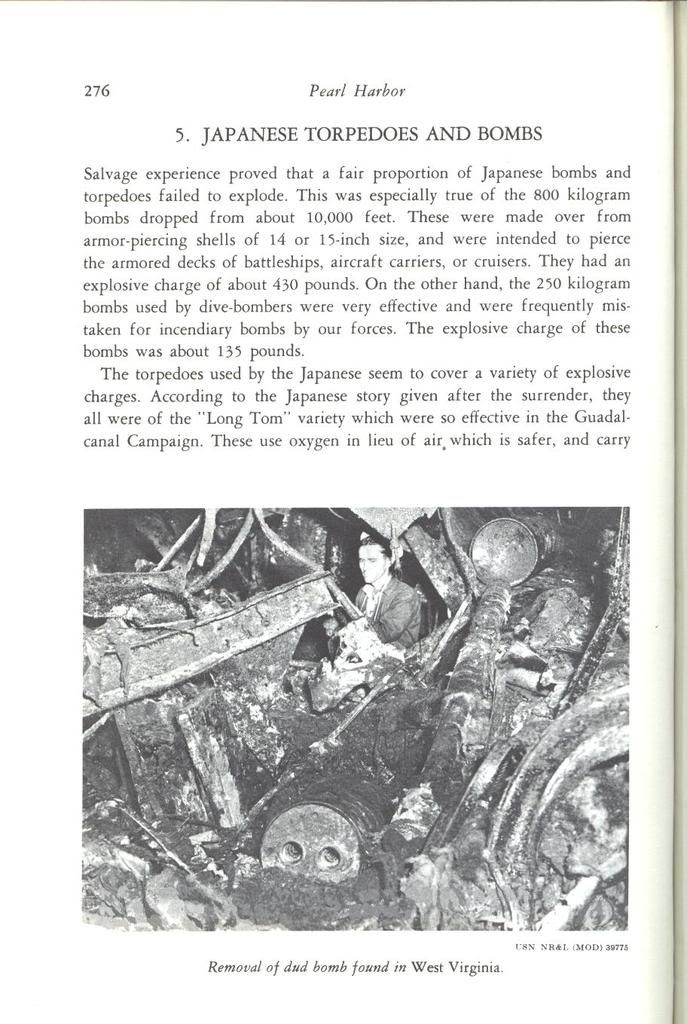
Here is a page from the US Navy history Pearl Harbor, Why, How, fleet salvage and Final Appraisal 1968, The Navy has been wrong but it might help.....
Thu Feb 28, 2008 9:57 am
Ship Strike Pacific by john Bruning has a excellent chapter related to the PH attack down to individual actions by groups and pilots. Great detail and gets right to specifics.
http://www.amazon.com/Ship-Strike-Pacific-John-Bruning/dp/0760320950
http://www.amazon.com/Ship-Strike-Pacific-John-Bruning/dp/0760320950
Thu Feb 28, 2008 10:44 am
David_Aiken wrote:Dan K wrote:Traditionally the credit for the shell bombs' design has been given to Petty Officer Noboru Kanai, a Kate bombardier who flew off the Soryu during the attack at Pearl. Kanai-san's bomb is apparently the one that set off the Arizona's magazine.
Hi Dan,
The "Kanai Tradition" for the BOMBING of the USS Arizona (not the design of the bomb) began -and ended- with Dr Gordon Prange in his TORA! TORA! TORA! (Tokyo: Reader's Digest; 1966) and was not corrected for his English version of that book titled AT DAWN WE SLEPT (NY: MacMillian, 1981).
In 1967, the Japanese War History Office released SENSHI SOSHO: HA-WA-I SAKUSEN...their official history of the Pearl Harbor Attack. Thus, Prange found MANY errors in his TORA volume, among which is the credit to Kanai for the destruction of the USS Arizona. He began his changes for his English version of his book and completed the 'cause' and 'effect' sections before his death in 1980.
The tactical section of AT DAWN WE SLEPT stinks.
The high-level bombs were dropped in groups of five (one bomb per KATE). You may read a bit about this in BATTLESHIP ARIZONA by Paul Stillwell (Annapolis; USNI; 1989) by checking the index for John DeVirgilio and my name. The five B5N2 from the HIRYU led by Tadashi KUSUMI hit the Arizona and the repair ship Vestal -one bomb of the five hit each ship. The trained bombardier for the five planes was Shomatsu KOBAYASHI, in the #2 aircraft, the other four bombardiers only toggled their bomb release. Read more of this in John DeVirgilio's "Seven Seconds to Infamy" Naval Institute Proceedings, Dec 1997.
The special bomb used at Pearl Harbor, was a "16 inch" naval artillery shell which had been turned on a lathe to an aerodynamic shape with added fins. Alas, for Japan, this weapon failed to do its job. Except for the fluke of destroying the Arizona, that weapon failed in all other drops. Japan never used this weapon again.
Hope this helps,
David Aiken
Ah, good...a reliable historian puts another tradition to rest.
So, what's the true story with Kanai-san? Was he even at Pearl? Did he crew on Kates? Did he serve aboard Soryu? Sorry for all the questions--just curious about how these myths get started.
Thu Feb 28, 2008 11:14 am
Dan K wrote:So, what's the true story with Kanai-san? Was he even at Pearl? Did he crew on Kates? Did he serve aboard Soryu? Sorry for all the questions--just curious about how these myths get started.
Kanai was a well trained bombardier from the SORYU. He targeted the paired WEEVEE and TENN. He was also at Wake Island where enroute back to his ship he was shot down by an F4F. He left behind a neat diary of his adventures through the end of Pearl Harbor. This diary was published by the SORYU REUNION ASSN in a VERY short run.
Cheers,
David Aiken
Thu Feb 28, 2008 11:17 am
Jack Cook wrote:Ship Strike Pacific by john Bruning has a excellent chapter related to the PH attack down to individual actions by groups and pilots. Great detail and gets right to specifics.
http://www.amazon.com/Ship-Strike-Pacific-John-Bruning/dp/0760320950
Aloha Jack,
John Bruning, Junior, interviewed me for his book as well as utilized much of my writings. Some day I hope to get a copy.
Cheers,
David