PBY-5/-5A bow turret
Thu Sep 19, 2013 1:54 pm
Gentlemen,
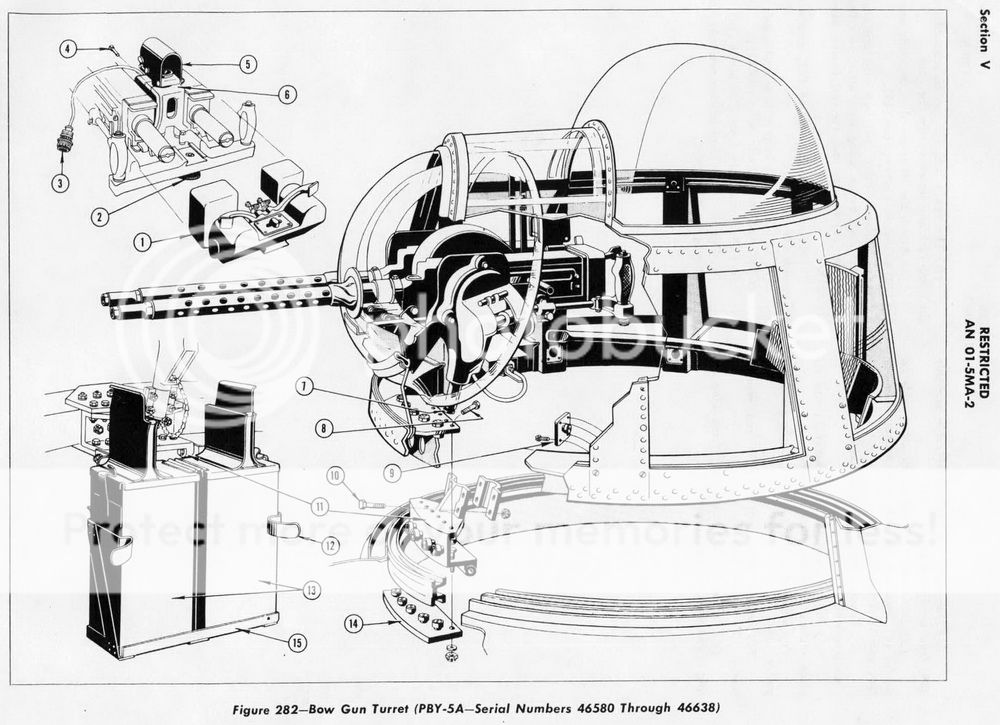
I was recently reading the Handbook of E&M for PBY-5 and PBY-5A (exact # AN 01-5MA2) and saw a drawing of the bow turret with 2 guns with the note that NONE of the production PBY-5 flying boats received such a turret, and only the PBY-5A amphibians after BuNo 46580 had this particular type (and not the "flat top").
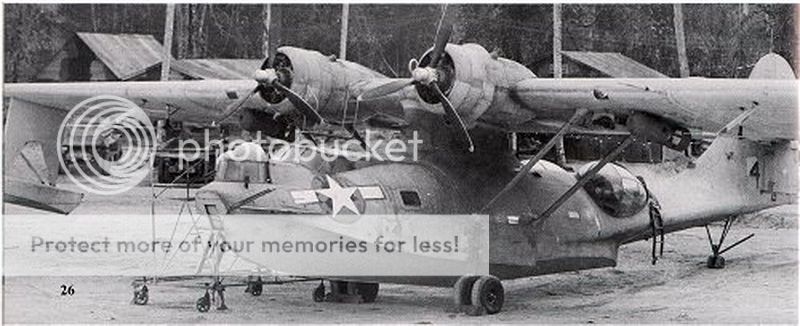
Remembering that I've already seen a different example, I quickly found this photo from VP 71:
Probably there are more.
Does anybody know was this a field mod? Are the 2 turret types interchangeable?
BTW, how do you open the top hatch of this particular model? Where does the Plexiglas top (the spherical one) go?
Thanks in advance!
Cheers!
I was recently reading the Handbook of E&M for PBY-5 and PBY-5A (exact # AN 01-5MA2) and saw a drawing of the bow turret with 2 guns with the note that NONE of the production PBY-5 flying boats received such a turret, and only the PBY-5A amphibians after BuNo 46580 had this particular type (and not the "flat top").
Remembering that I've already seen a different example, I quickly found this photo from VP 71:
Probably there are more.
Does anybody know was this a field mod? Are the 2 turret types interchangeable?
BTW, how do you open the top hatch of this particular model? Where does the Plexiglas top (the spherical one) go?
Thanks in advance!
Cheers!
Last edited by catch 22 on Thu Sep 19, 2013 5:36 pm, edited 1 time in total.
Re: PBY-5/-5A bow turret
Thu Sep 19, 2013 2:07 pm
interesting post & 1st i've seen of that turret configuration. what I question is why do so many post ww2 pby warbirds never have the original nose turret?? to boxey for aerodynamics?? no parts around?? faa stipulation??
Re: PBY-5/-5A bow turret
Thu Sep 19, 2013 2:21 pm
tom d. friedman wrote:I question is why do so many post ww2 pby warbirds never have the original nose turret?? to boxey for aerodynamics?? no parts around?? faa stipulation??
Actually I've seen some Catalinas restored with the same turret. Like this one in the National Warplane Museum (I guess):

But they are really not many...
Re: PBY-5/-5A bow turret
Thu Sep 19, 2013 4:16 pm
The PBY being restored at Grant County airport in Moses Lake, WA might have that turret. It was the last one built in Louisiana. When I saw it, it had the metal for the turret but none of the plexiglass.
Re: PBY-5/-5A bow turret
Thu Sep 19, 2013 11:36 pm
It seems to me that this modified bow turret would have greatly restricted the forward vision of the flight crew.
Re: PBY-5/-5A bow turret
Fri Sep 20, 2013 11:21 am
tom d. friedman wrote:interesting post & 1st i've seen of that turret configuration. what I question is why do so many post ww2 pby warbirds never have the original nose turret?? to boxey for aerodynamics?? no parts around?? faa stipulation??
I heard something once (don't remember where) along the lines that post-war civilian registered/operated PBY's were prohibited, presumably by the FAA and/or its predecessors, from operating on the water if the nose turret was still installed. Apparently there was too much potential for water to get into the bow of the airplane and swamp it, so most people took them off and faired over the hole. That's what I heard anyway....
Last edited by Rajay on Sun Sep 22, 2013 10:50 am, edited 1 time in total.
Re: PBY-5/-5A bow turret
Fri Sep 20, 2013 5:30 pm
The guy that I apprenticed under way back in the day was involved in the conversions to the hurricane bow as they called it.Anyone want to guess where this work was carried out? Right there at chino.His name was Jerry Bachsbauer.
Re: PBY-5/-5A bow turret
Fri Sep 20, 2013 9:35 pm
At least two of the PBYs blown up in Tora! Tora! Tora! had the late turrets. My Photobucket is in limbo as usual but here's a good view of one on a lobby card:
UQ~~60_12.JPG)
Re: PBY-5/-5A bow turret
Sat Sep 21, 2013 5:44 am
First time I ever noticed that. And I've seen tora tora tora so many times
Re: PBY-5/-5A bow turret
Sun Sep 22, 2013 7:18 am
Rajay wrote:tom d. friedman wrote:interesting post & 1st i've seen of that turret configuration. what I question is why do so many post ww2 pby warbirds never have the original nose turret?? to boxey for aerodynamics?? no parts around?? faa stipulation??
I heard something once (don't remember where) along the lines that post-war civilian registered/operated PBY's were prohibited, pesumably by the FAA and/or its predecessors, from operating on the water if the nose turret was still installed. Apparently there was too much potential for water to get into the bow of the airplane and swamp it, so most people took them off and faired over the hole. That's what I heard anyway....
Rajay this is true and I have heard and read the same.
In addition and of particular importance to civilian /commercial usage is the considerable weight saving achieved by full removal of the turret and its associated rings (rotation tracks) and dolly wheels.
.
Re: PBY-5/-5A bow turret
Sun Sep 22, 2013 7:27 am
hang the expense wrote:The guy that I apprenticed under way back in the day was involved in the conversions to the hurricane bow as they called it.Anyone want to guess where this work was carried out? Right there at chino.His name was Jerry Bachsbauer.
Interesting. Here in Australia we called them "clipper bows" and the turret was called the "Eye Ball" Turret.
At HARS our metal bashers on the Catalina crew are currently scratch building a new Eye Ball turret to hopefully fit to our PBY-6A "Felix"
.
Re: PBY-5/-5A bow turret
Sun Sep 22, 2013 12:05 pm
BAJ wrote:Interesting. Here in Australia we called them "clipper bows" and the turret was called the "Eye Ball" Turret.
Hi BAJ!
I would say the new turret is known as "Eye ball" not only in Australia.
 This is the usual name for it all over the world (I guess). There are some small differences between the one I have shown above and the modified type wit a metal hatch as below.
There is also an old thread in the forum about the "clipper bows" and other changes made to the "Catalinas" here.
BTW all the "Catalinas" shown in "Tora, tora, tora" have the eye-ball turret and the wing thermal de-icing system, which is incorrect for the historical period.


And speaking of movies: the "Cat" in "The Battle of Midway" is also some "back-to-the-future"
aircraft with a clipper bow and a high tail of a PBY-6A: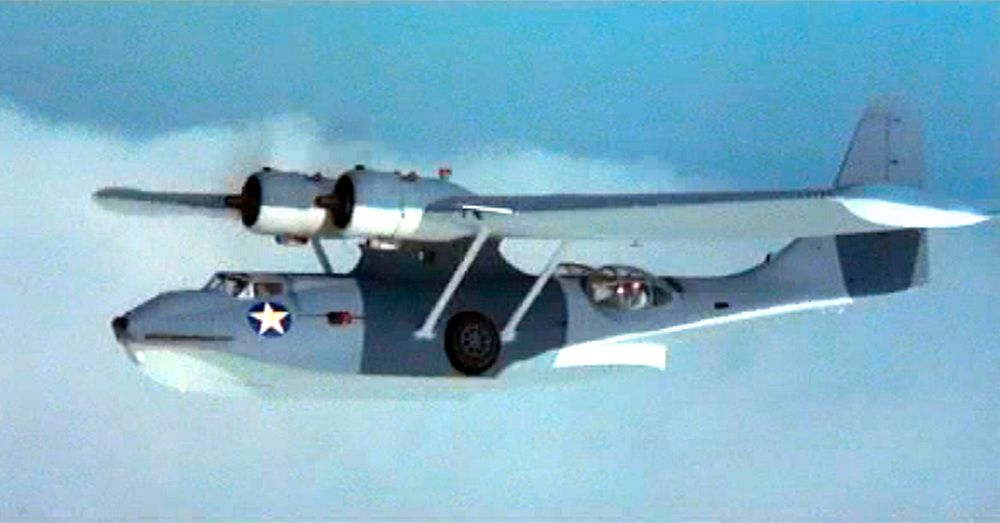
But once again my initial question: does anybody know how do you open the hatch of the eye-ball turret? There are no hinges and I guess the hatch must be removed completely (to the inside?)
Re: PBY-5/-5A bow turret
Mon Sep 23, 2013 6:11 am
But once again my initial question: does anybody know how do you open the hatch of the eye-ball turret? There are no hinges and I guess the hatch must be removed completely (to the inside?)
Certainly, the early turret had the removable top panel which is held in place by 4 over centre clips with the hatch removed completely to the inside of the aircraft or outside on a lanyard.
As to the eyeball turret, logic would dictate the it must have still had a removable top panel for ease of mooring and continuance of existing operation procedures
.
Certainly, the early turret had the removable top panel which is held in place by 4 over centre clips with the hatch removed completely to the inside of the aircraft or outside on a lanyard.
As to the eyeball turret, logic would dictate the it must have still had a removable top panel for ease of mooring and continuance of existing operation procedures
.
Re: PBY-5/-5A bow turret
Mon Sep 23, 2013 9:15 am
i've always wondered what that "wash board" looking panel just under the turret was for.
Re: PBY-5/-5A bow turret
Mon Sep 23, 2013 10:25 am
From the FAA Type Certificate Data Sheet:
http://www.airweb.faa.gov/Regulatory_and_Guidance_Library/rgMakeModel.nsf/0/9a1ffca00d7cc667862575f60064120f/$FILE/TC%20785.pdf
http://www.airweb.faa.gov/Regulatory_and_Guidance_Library/rgMakeModel.nsf/0/9a1ffca00d7cc667862575f60064120f/$FILE/TC%20785.pdf
(2) To be eligible for maximum weight of 28,000 lbs., a clipper bow in accordance with CVAC Drawing
No. 28B15001 B and pertinent detail drawings must be installed. The airplane is eligible for a
maximum weight of only 27,000 lbs. with the original PBY-5A nose and turret installed, provided the
turret revolving mechanism is removed or made inoperative and the opening between the nose and turret
are faired over.
(3) The rear gun blisters must be removed and a satisfactory passenger door installed. The number of
auxiliary exits required will be governed by CAR 3.387. The navigator’s escape hatch in the top of the
cabin near bulkhead 3 will be considered as one auxiliary exit, provided it is properly placarded and a
suitable ladder or other equivalent means of access is stowed adjacent to the hatch so as to readily
permit easy egress through the hatch.
NOTE 9. Model 28-5ACF is approved with retention of waist blisters and a modified clipper bow at a maximum take-off andlanding weight of 27,880 lbs. when modified per So. California Aircraft Corp., Ontario, CA., Form ACA-337,
dated 12/27/48. Airplane Flight Manual must be revised in accordance with approved manual for aircraft N69043
owned by the So. California Aircraft Corp., Ontario, CA. When such blisters are retained, the fixed elevator trim
tab, described in CVAC Drawing 28T15024, must not be incorporated.
NOTE 10. Under wing boats may be installed in accordance with So. California Aircraft Corp., Ontario, CA, Form ACA-337,
dated 6/6/50. P&W R-1830-75 engines may be installed in accordance with So. California Aircraft Corp., Form
ACA-337, dated 5/2/51.