The Brooklands Museum has a walkthrough Vickers Wellington fuselage that is mostly reconstructed material that was spare from the restoration of R for Robert (N2980).
Attachment:
Wellington_walkthrough.jpg [ 232.17 KiB | Viewed 10224 times ]
_________________ A Little VC10derness - A Tribute to the Vickers VC10 - www.VC10.net
According to the book A History of Aircraft Piston Engines, the Chrysler XIV-2220-1 at the New England Air Museum is mounted on a stand that allows visitors to rotate it longitudinally to view it from different angles: [Link to Image] (Source: WW2Aircraft.net)
Also, one from our museum that I've always enjoyed the creativity of - although I can't take credit for it. One of the volunteers, Dennis Stewart, came up with the idea of keeping the parachute on a scale paratrooper that hangs from fishing line over the lobby open by cutting the top ring off a hanging plant basket and inverting it inside as a framework:
Attachment:
Paratrooper with Hanging Plant Basket Frame in Parachute (Cropped, Reduced, Converted).png [ 996.85 KiB | Viewed 10068 times ]
Similar to the rendering of the P-51 drop tank at NASM mentioned in a previous post, the Finnish Air Force Museum has a display with a Thulin type D dropping leaflets that are suspended along the rear fuselage as if they had just been released: [Link to Image] (Source: Finnish Air Force Museum)
The National Soaring Museum has a circular display with hanging models of gliders and what appear to be signs identifying them: [Link to Image] (Source: Uncovering New York)
While there are plenty of museums displaying collections of models, this layout seemed both particularly well thought and laid out.
The Beechcraft Heritage Museum has an "Engine Shop" that has exploded views of engines, similar to an example in a previous post. However, what is particularly well done is a "visible" engine, similar to a Link trainer and Mirage F1 mentioned in previous posts, made out of plexiglass showing how all of the components mount to and in it: [Link to Image] (Source: Flickr)
Ever since our museum started using our Heath LNB-4 Super Parasol as a kids climb in exhibit, I have been pondering the best aircraft for that purpose. The LNB-4 isn't ideal because the various control cables and struts leading out to the wing make it difficult to enter. For a while, I considered a Cessna 150 as being small and relatively cheap, but it still has the same problem the LNB-4 does of having a high wing that it is possible to hit your head on. Then, the other day, I came across the example at the College Park Aviation Museum, an Ercoupe:
It has the rear fuselage removed at what appears to be a production break, which reduces the overall size, and the clear plexiglass cover allows visitors to see the inside. However, at the same time, it avoids one of the problems that comes with only having a cockpit section: it still retains all three landing gear, which means it can be easily moved. In addition, because it retains the engine, it much more readily identifiable as an airplane. The downside is that with the wings and tail missing, it is not possible for kids to see the control surfaces move when they manipulate the yoke and rudder pedals.
The Stafford Air & Space Museum has an interactive demonstration of machine gun interrupter:
It is similar to the motorized rotary versus radial comparison in a previous post, except, to add an additional coolness factor, it is handcranked.
The Lincolnshire Aviation Heritage Centre has a sign explaining the mission markings on the nose of their Lancaster: [Link to Image] (Source: Flickr)
While not particularly innovative from a design perspective, what it does do is explain an aspect of aviation history that, while obvious to anyone with a background in it, isn't familiar to the general public in a very approachable manner.
Like the flak bursts in the display at the Atterbury-Bakalar Air Museum mentioned in a previous post, the Aviation Heritage Center of Wisconsin has two T-28s forming a heart with their display smoke: [Link to Image] (Source: Google Maps)
It has the rear fuselage removed at what appears to be a production break, which reduces the overall size, and the clear plexiglass cover allows visitors to see the inside. However, at the same time, it avoids one of the problems that comes with only having a cockpit section: it still retains all three landing gear, which means it can be easily moved. In addition, because it retains the engine, it much more readily identifiable as an airplane. The downside is that with the wings and tail missing, it is not possible for kids to see the control surfaces move when they manipulate the yoke and rudder pedals.
Maybe mount a model airplane on a pylon atop the cowling and hook the controls to the model surfaces? That way the kid manipulating the controls can easily see which surfaces are moved without having to turn around.
Similar to the Ki-61 mentioned in a previous post, the new exhibit at the Sullenberger Aviation Museum uses lights to simulate the waves of the river on the floor of the hangar: [Link to Image] (Source: Progressive Companies)
There's a number of aviation museums that display aircraft noses sticking out of the side of their building, but the Frontiers of Flight Museum is perhaps unique in that the nose of their Boeing 737-300 sticks in to the building through a gasket-sealed hole in the glass wall on the north end of the museum: [Link to Image] (Source: Aerial Visuals)
The famous O-1 that was landed on the USS Midway during Operation Frequent Wind is now suspended from the ceiling of Hangar Bay One at the National Naval Aviation Museum on a cable that rotates: [Link to Image] (Source: Aerial Visuals)
Akin to the visitor briefing room mentioned in a previous post, the Air Force Armament Museum has visitors sit in the same type of webbed seats used in aircraft while in the small theater in their special operations command gallery:
Attachment:
Air Force Armament Museum Theater Seats.png [ 987.79 KiB | Viewed 8187 times ]
The Air Zoo has the engine cowling from an A-10 that was damaged by a surface to air missile during Operation Iraqi Freedom: [Link to Image] (Source: Facebook)
Now, there are few displays that, while not particularly remarkable, I thought were particularly well done. First, the Greater Fort Wayne Aviation Museum has what appears to be a vitrine-encased set of models sitting on top of a vitrine encased engine. I initially thought that this was a single vitrine with multiple levels and, like the case at the Atterbury-Bakalar Air Museum mentioned in a previous post, was an interesting use of vertical space. However, it is still interesting for the idea: [Link to Image] (Source: Fort Wayne, Indiana)
In a similar airport display, Baltimore/Washington International Thurgood Marshall Airport has a well themed case of "Maryland Built Aircraft" put on by the Glenn L. Martin Maryland Aviation Museum: [Link to Image] (Source: X)
Also in the vein of themes, the South Yorkshire Aircraft Museum has line of cockpits called "Canberra Way". Not only being able compare the different variants of the aircraft neat to see, but each cockpit is well labeled with a large sign mounted to the support frame: [Link to Image] (Source: South Yorkshire Aircraft Museum)
Lastly, it is worth noting two more examples previously mentioned displays. The British Columbia Aviation Museum has the same type of interactive carrier landing model that was mentioned in a previous post and the Beechcraft Heritage Museum has its own version of the fabric covering process display mentioned in a previous post.
The Langham Dome, which is a visitor's center was a gunnery trainer during World War II, is based around a really cool exhibit. They have recreated the training experience by projecting an original training film on the inside of the structure and installed a mock gun in the center so that visitors can practice their shooting skills just like soldiers did during the war: [Link to Image] (Source: Langham Dome)
However, what makes it even more interesting is that they don't stop there. One page on their website traces the influence of the technology on developments to the present day while another page connects it to modern augmented reality.
Given that the Aichi M6A1 Seiran at the National Air and Space Museum is on floats, it had to have a platform built to allow it to be moved around. The platform has a set of wooden planks that, while it's not entirely clear if it was the intent to replicate it, certainly resemble the deck of the I-400 submarine that it would have sat upon before takeoff: (Source: Wikimedia Commons)
The Tangmere Military Aviation Museum has three pretty creative exhibits. One is the cockpit of Chipmunk T10, WZ876, which has been cutaway in an irregular manner [Link to Image] (Source: Tangmere Military Aviation Museum)
The second is one of the valve covers for a Rolls-Royce Griffon that is displayed elevated above the engine on a custom support as if in an exploded view: [Link to Image] (Source: Google Maps)
The final one is a stereoscopic viewer mounted on a set of rails that allows visitors to slide it left and right to interpret a series of aerial reconnaissance photos for themselves:
Attachment:
Tangmere Military Aviation Museum Viewer.png [ 670.46 KiB | Viewed 7267 times ]
Instead of the traditional vitrines, the Air Force Flight Test Museum has used aircraft canopies for their display cases: [Link to Image] (Source: Google Maps)
The New England Air Museum has a really neat new exhibit about Igor Sikorsky that allows visitors to experience what it is like to be rescued by a helicopter by letting them climb in a rescue basket complete with stormy sea base and backdrop: [Link to Image] (Source: New England Air Museum via Facebook)
The Glenn L. Martin Maryland Aviation Museum has a very unique education program called "B-26 Assembly Team" in which children assemble a life-size mockup of the aforementioned aircraft with a "1942" fuselage code. The exhibit was designed by Dorsey Boyle and Frank Fahdt and is made up of a framework of frames and longerons onto which removable skin panels can be mounted: [Link to Image] (Source: Pan Am Historical Foundation) [Link to Image] (Source: Glenn L. Martin Maryland Aviation Museum)
Attachment:
File comment: B-26 assembly fuselage Avenue News, 6 February 2020, Page 22.png [ 458.15 KiB | Viewed 6594 times ]
The Nationaal Militair Museum, in an exhibition designed by Kossmann.Dejong and implemented by Bruns, displays an F-16 with the nose landing gear off the ground as if the aircraft has just started taking off instead of just using the traditional three-point attitude. It adds a dynamic nature to what is otherwise a static exhibit: (Source: Wikimedia Commons)
This idea extends throughout the museum, as a sequence of gradually rolling fighter jets - an F-84F, Hunter F.4, F-104G and NF-5 - are hung overhead. They not only give the appearance of a single aircraft completing a roll, but by showing the successive fighters used by the Dutch Air Force also act as an implicit timeline of the development of military aviation: [Link to Image] (Source: Anne Reitsma via Greater Venues)
A third exhibit is a variation on the "visible aircraft" idea mentioned in a previous post, but instead opts for using separate sections of an airframe, rather than one integral unit: [Link to Image] (Source: Flickr)
The Polish Aviation Museum has recreated the conditions of the Cold War-era in an original hangar moved to the museum for that purpose: [img=http://www.muzeumlotnictwa.pl/wp-content/uploads/2025/11/SZW_0010_IMG_0182.png][Link to Image][/img] (Source: Muzeum Lotnictwa Polskiego)
Following on some other creative uses of light mentioned a previous posts (1, 2, 3, 4), Aerospace Bristol projects a video showing the operation of the aircraft's Rolls-Royce/Snecma Olympus 593 engines onto the side of its Concorde: (Source: Wikimedia Commons)
The Bomber Command Museum of Canada has a tail gun turret from a Halifax that not only rotates and elevates, but also has sound effects and lights in the ends of the gun barrels to simulate muzzle flashes:
The Hangar Flight Museum has taken the three-dimensional idea mentioned in a previous post one step further and incorporated a whole bunch of raised elements: (Source: EAA)
The open-again, closed-again TAM Museum has an array of eight propellers mounted to the wall on a frame that appears to allow them to rotate via chain: (Source: Wikimedia Commons)
The Vietnam Military History Museum displays a MiG-21PF, 4324, outside under a unique blue tinted canopy: (Source: Wikimedia Commons)
The since renamed Travis AFB Heritage Center has an R-3350 mounted on what I'm guessing might be an old maintenance stand. What makes it particularly neat is that the propeller shaft at the front is the only attach point, so that there are no distracting supports in pictures or obstructions preventing visitors from examining the engine: (Source: Wikimedia Commons)
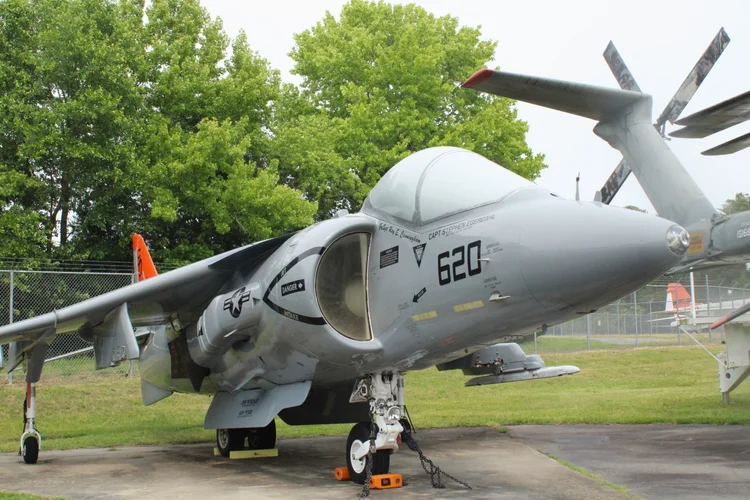
By the same token, the Patuxent River Naval Air Museum has bird-proofed the engine intakes on its AV-8B with clear plexiglass rather than solid red plugs or metal mesh: (Source: Patuxent River Naval Air Museum)
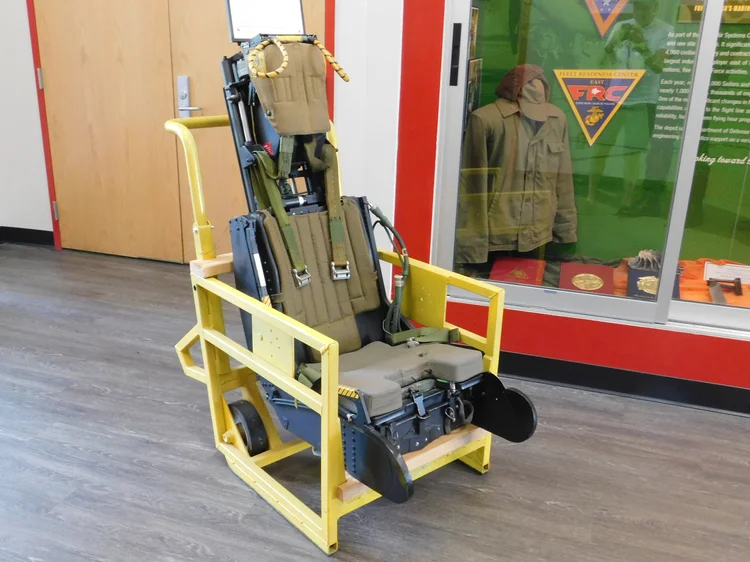
In another case of I-don't-know-if-this-is-leftover-maintenance-equipment, the Havelock Tourist & Event Center has an ejection seat sitting in a yellow wheeled frame that allows for easy movement: (Source: Aviation History Museums)
The Museo Nacional Aeronáutico y del Espacio, or at least its local model club, have labels that replicate aircraft data plates (Source: Aviones a Escala)
I had a similar idea to disguise an object number label as a dog tag on a mannequin:
Attachment:
Mannequin Labeled with Faux Dog Tag (Reduced, Converted).png [ 836.29 KiB | Viewed 372 times ]
Finally, the Science Museum in London did something close to the above with the BMW 801 they have on display: (Source: IPMS Stockholm)
Users browsing this forum: No registered users and 204 guests
You cannot post new topics in this forum You cannot reply to topics in this forum You cannot edit your posts in this forum You cannot delete your posts in this forum You cannot post attachments in this forum



 Login
Login Register
 FAQ
FAQ Search










![[Link to Image]](http://www.airforcemuseum.fi/wp-content/uploads/2023/05/IMG_0089.jpg)
![[Link to Image]](http://www.uncoveringnewyork.com/wp-content/uploads/2023/02/National-Soaring-Museum-1827.jpg)
![[Link to Image]](http://live.staticflickr.com/65535/52464766254_99c8b83948_o.jpg)
![[Link to Image]](http://www.pgparks.com/wp-content/uploads/2023/02/CollegeParkAviationMuseum19-40_1200.jpg)
![[Link to Image]](http://live.staticflickr.com/65535/53577910872_020f419458_o.jpg)
![[Link to Image]](http://scontent-ord5-2.xx.fbcdn.net/v/t1.6435-9/80575442_2483084445137472_9150508341879898112_n.jpg?_nc_cat=110&ccb=1-7&_nc_sid=13d280&_nc_ohc=Hri60cBDUwgQ7kNvgETiumv&_nc_ht=scontent-ord5-2.xx&oh=00_AYAUkpedezZgqcs-jGnH9yFXpI626klpQETfypFppp5vbw&oe=66AFD5D2)
![[Link to Image]](http://cdn.prod.website-files.com/650993004df1c07c098563a8/66fea4394c2791513e2e371d_SAM%20website%2009.jpg)
![[Link to Image]](http://www.aerialvisuals.ca/Airframe/Gallery/0/115/0000115906.jpg)
![[Link to Image]](http://www.aerialvisuals.ca/Airframe/Gallery/0/5/0000005831.jpg)
![[Link to Image]](http://scontent-ord5-2.xx.fbcdn.net/v/t39.30808-6/434593255_819938496842946_7125786998106337997_n.jpg?_nc_cat=105&ccb=1-7&_nc_sid=127cfc&_nc_ohc=9KFbI54ZVX4Q7kNvgGcUr-J&_nc_zt=23&_nc_ht=scontent-ord5-2.xx&_nc_gid=AaJuZx7bGyqqlPV9egu0Q3X&oh=00_AYAnZNlcSd4zXBIOZxMMDMb-jURBWrE46ntPi9q_dopkfA&oe=67388A23)
![[Link to Image]](http://assets.simpleviewinc.com/simpleview/image/upload/c_fill,h_898,q_75,w_1200/v1/clients/fortwayne/FWA-Aviation-Museum_e17a7370-eb08-4817-068f3c906b0a348e.jpg)
![[Link to Image]](http://static.wixstatic.com/media/b98642_94b1ff4669d64912bef707f16d79482f~mv2.png)
![[Link to Image]](http://www.langhamdome.org/wp-content/uploads/2014/06/IMG_2566.jpg)

![[Link to Image]](http://tangmere-museum.org.uk/wp-content/uploads/2023/12/De-Havilland-Chipmunk-Cockpit.jpg)
![[Link to Image]](http://scontent-ord5-3.xx.fbcdn.net/v/t39.30808-6/469752335_965974932230167_1248255320085172610_n.jpg?_nc_cat=110&ccb=1-7&_nc_sid=127cfc&_nc_ohc=Bbv_B8B9W2EQ7kNvgEkD3K_&_nc_zt=23&_nc_ht=scontent-ord5-3.xx&_nc_gid=AT6xKSZ8BL-OlCmsNmAKF_2&oh=00_AYBFqJn1NyfkFO-eiaXHQahkc5SPlW7IyKfRuLBLnh-COg&oe=67A619F2)
![[Link to Image]](http://www.panam.org/images/igallery/resized/4801-4900/Dorsey_Boyle__l__and_Frank_Fahdt_designed__build_your_own_fuselage__learning_project-4883-1400-600-100.jpg)
![[Link to Image]](http://static.wixstatic.com/media/771b52_0a7e8b7edb864b509ef1137a456523b0~mv2.jpg)
.jpg)
![[Link to Image]](http://www.greatervenues.com/wp-content/uploads/2017/09/vliegtuigen_en_tanks_in_arsenaal_anne_reitsma.jpg)
![[Link to Image]](http://live.staticflickr.com/7595/16849233896_f0e021b139_b.jpg)

.jpg)
