Mon Feb 11, 2008 9:53 pm
Mike wrote:bdk wrote:I thought Vraciu flew an F6F-3.gregv wrote:Isn't TFC's Hellcat one flown by Vraciu?
Don't let's go there!

Well, if we're not going to go there, can you at least describe to me the general look of the scenery if we did?
Would I be correct in guessing that I should have said "purportedly flown"?....
cheers
greg v.
Mon Feb 11, 2008 10:42 pm
Back to colors, the Hellcat cockpit should be "interior green" (actually a mix of zinc chromate yellow and a little black.) It's not the bright "apple green" sometimes seen on models and restored aircraft. The instrument panel and consoles were black. If you're building a -3, the area inside the rear windows was "Grumman Gray," basically just a generic light gray color. The inside of the cowl was gray as well. The wheel wells should be the same color as the underside.
SN
SN
Mon Feb 11, 2008 10:42 pm
I thought something like the fuselage was one of his real aircraft or something. I don't remember where I heard that.
Mon Feb 11, 2008 11:49 pm
mustangdriver wrote:I thought something like the fuselage was one of his real aircraft or something. I don't remember where I heard that.
The story was that the center section was from one that Alex Vraciu had flown. It was certainly advertised as such for several years, but I believe that this has since been debunked. Either way, the TFC aircraft was painted Vraciu's markings.
Cheers,
Richard
Tue Feb 12, 2008 3:12 am
Hi Steve Nelson- you get the point as well in few hours I will start spray interior and this is valuable info. So cowling inside as well beck of the seat is grey. All right 

Tue Feb 12, 2008 7:23 am
Just to clarify..the cockpit and seat are interior green. The backside of the armor plate and inside of the rear fuselage are gray.
SN
SN
Tue Feb 12, 2008 8:00 am
I have understand you good and paint my scale model just like that. Soon I will open separate topic about this kit.
Cheers
Cheers
Tue Feb 12, 2008 8:45 am
Here are a few shots I took of the inside of the Fleet Air Arm Museum's Hellcat II KE209. Many of the immediate surfaces (seat, rudder pedals, side panels etc.) in the cockpit that used to be tinted green zinc have been painted over with British interior green. It appears to have been applied after it came out of service and I would guess by museum personnel. I do not know if the "fresh" paint covers a layer of period applied British interior green paint.
I think that these surfaces were painted tinted zinc when she came from the Grumman Factory.
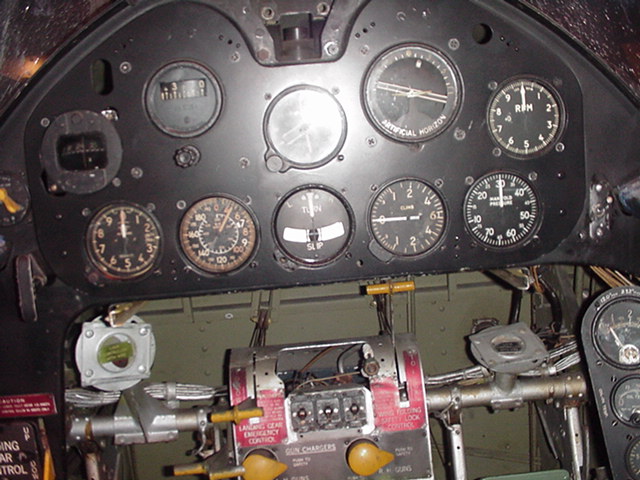
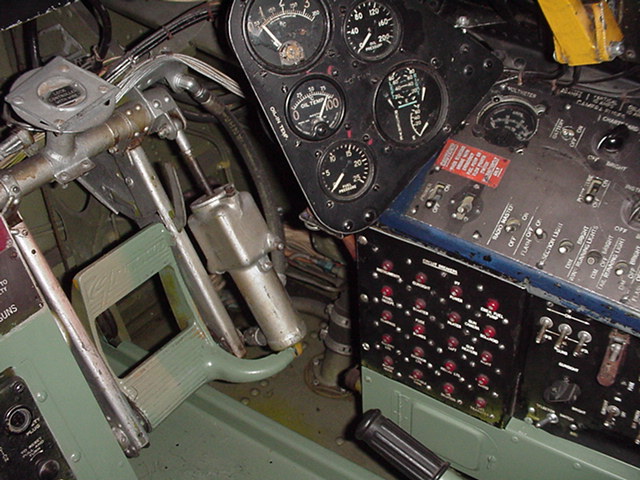
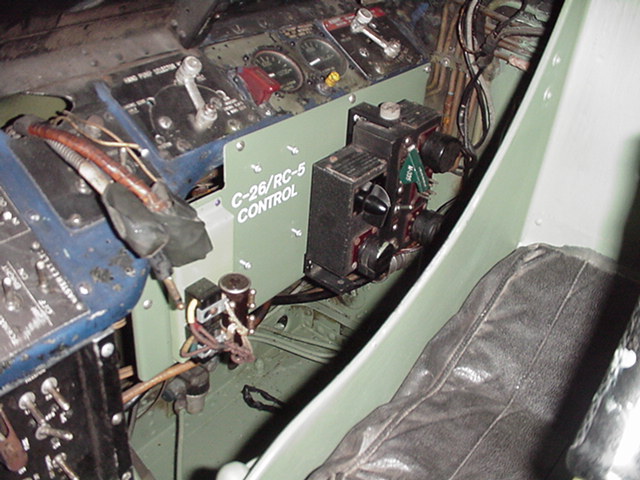
The interior surfaces of the rear of the armor plate and the rear fuselage of a typical F6F-5, by my experience, should be tinted zinc chromate (also called green zinc). The interior of the rear fuselage of the FAAM appears to be factory original. Note the uneven thickness of paint with extra attention to the stringers and bulkheads.

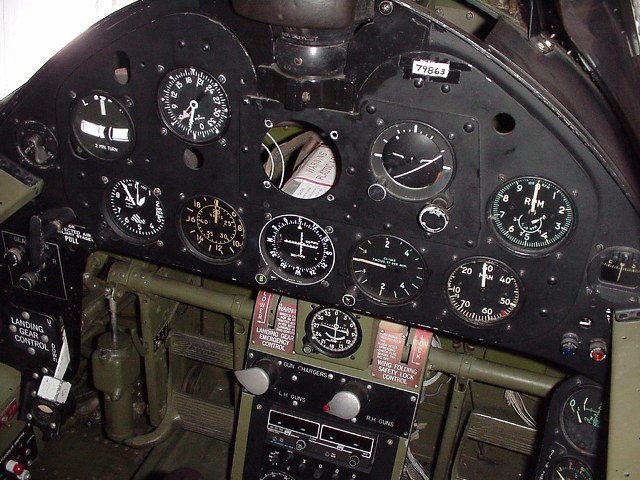
Here are shots of the F6F-5K BuNo 79863 that presently belongs to (or used to anyway) the Flying Heritage Collection. Keep in mind that this aircraft appears to have been through typical Navy overhaul at Pensacola around 1957 (assuming for its drone mission) and it received pretty much a good overall hosing of tinted zinc. This was a common practice.
Also note that this aircraft appears to have had a renovation/ "restoration" in the early 1970's.

I think that these surfaces were painted tinted zinc when she came from the Grumman Factory.
The interior surfaces of the rear of the armor plate and the rear fuselage of a typical F6F-5, by my experience, should be tinted zinc chromate (also called green zinc). The interior of the rear fuselage of the FAAM appears to be factory original. Note the uneven thickness of paint with extra attention to the stringers and bulkheads.
Here are shots of the F6F-5K BuNo 79863 that presently belongs to (or used to anyway) the Flying Heritage Collection. Keep in mind that this aircraft appears to have been through typical Navy overhaul at Pensacola around 1957 (assuming for its drone mission) and it received pretty much a good overall hosing of tinted zinc. This was a common practice.
Also note that this aircraft appears to have had a renovation/ "restoration" in the early 1970's.
Tue Feb 12, 2008 9:30 am
Here are some shots I took of the F6F-3 at the National Museum of Naval Aviation. You can see the gray through the windows behind the cockpit. Of course, this is a restoration..but it's fairly accurate from what I've read. I doubt you there would have been seat cushions in a wartime aircraft, though.
SN


SN
Tue Feb 12, 2008 10:00 am
Images of the preserved airplans is more then useful and I am really grateful for posting them here. In regard to your advice and material provided I have made some first step in paint job.
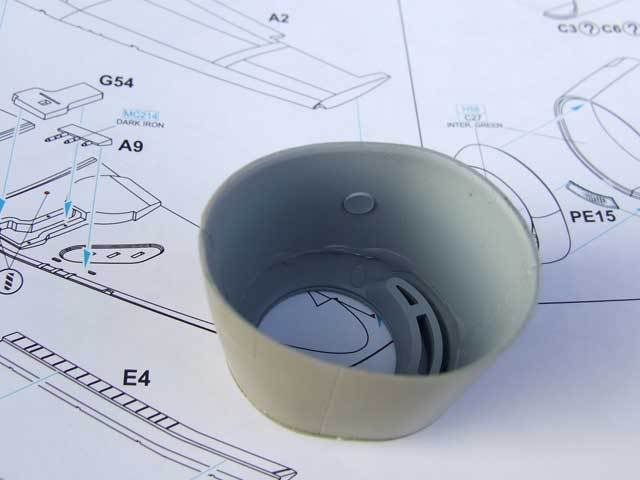
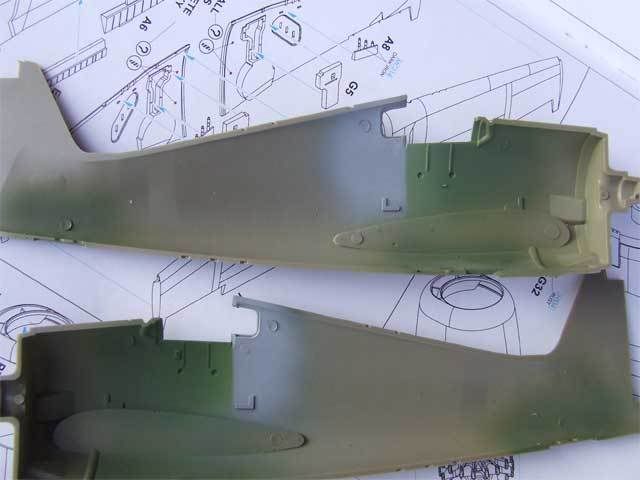
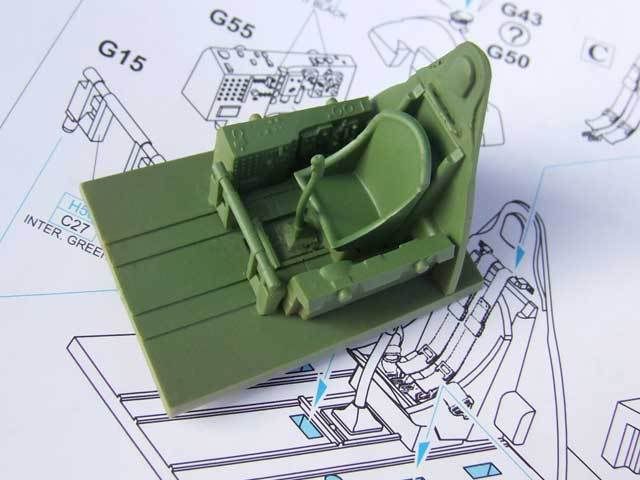
Your comment is more then welcome
Your comment is more then welcome
Tue Feb 12, 2008 11:31 am
from Hyperscale's "Plane Talking" forum (http://www.clubhyper.com/forums/forum.htm), a thread entitled "F6F-3 Helllcat Primers and coatings" from January 29/08:
"About a week ago someone posted about camouflage colors being applied to a seemingly NMF F6F-3 Hellcat. I did some digging and found my copy of the 3/3/43 revision of the F6F-3 specs. for the application of the protective coatings and finish. I'm going to summarize this to keep it less technical. Here goes.
This applies to F6F-3, Hellcats, BuNo. 04775-05054 and 08894-09038 which would be the first two production batches of Hellcats for the fleet. Later aircraft are generally similar.
The first section deals with finish requirements according to Navy requirements of Spec. SR15-C. It states that Non-specular Sea Blue, Semi-gloss Sea Blue, Intermediate Blue and Insignia White are the colors for the airframe exterior. These colors replace aluminized lacquer as an exterior finish. That would have been the prototype Hellcats. They also replace the earlier Non-specular Blue-Gray and Non-specular Light Gray finish.
A shop coat of primer was required. This was applied as soon as possible after parts or assemblies were fabricated. This was thinned zinc chromate primer and comprised the first coat of the finish. The first coat of the finish system was this zinc chromate shop coat.
Tinted primer replaces aluminized zinc chromate primer. Tinted primer is made by mixing ten ounces of black enamel with one gallon zinc chromate primer. “The color resulting from the above will vary and is not required to match any color standard.” (My quotes) The result of this is Interior Green, similar to ANA 611 or FS 34151.
Tinted primer replaces semi-gloss Bronze Green on the interior of the cockpit.
It’s interesting to note that 11 gallons of Zinc Chromate and 15 gallons of Tinted Zinc Chromate were required for each Hellcat produced.
It’s also interesting to note that 5.5 ounces of Indian Red, paste were required as well. I have seen this ‘Salmon’ primer on the structure of the elevators of recovered parts.
The exterior was considered a Class ‘A’ surface and was to receive 1 coat of zinc chromate primer (shop coat) and 2 coats of the appropriate camouflage color. This also included the cockpit which received two coats of ‘darkened primer’ (My quotes). This resulted in the cockpit having two coats of interior green primer.
It also states that ready mixed non-specular gray should be thinned with 1 ¼ parts thinner to 1 part non-specular gray. This was applied to the entire interior surface of the airframe excluding the cockpit.
The firewall was not to be painted. The entire airframe was to be painted with zinc chromate primer and then the finish coats according to the type of service the part was subjected to. The exception was Class ‘D’ surfaces which were anodized parts.
It is interesting to note that in the painting chart dated April 15, 1944 the National insignia (Stars with Bars) on the upper left wing was not required to have Insignia Blue applied to the border. A photo of a Hellcat with this exact style insignia appears in the old Aerodata International book on US Navy Fighters of WW2. Further the Insignia White on the National insignia was to be painted with a 1:1 mix of Non-specular Light Gray and Non-specular Insignia White.
Hope this all makes sense.
William Reece"
"About a week ago someone posted about camouflage colors being applied to a seemingly NMF F6F-3 Hellcat. I did some digging and found my copy of the 3/3/43 revision of the F6F-3 specs. for the application of the protective coatings and finish. I'm going to summarize this to keep it less technical. Here goes.
This applies to F6F-3, Hellcats, BuNo. 04775-05054 and 08894-09038 which would be the first two production batches of Hellcats for the fleet. Later aircraft are generally similar.
The first section deals with finish requirements according to Navy requirements of Spec. SR15-C. It states that Non-specular Sea Blue, Semi-gloss Sea Blue, Intermediate Blue and Insignia White are the colors for the airframe exterior. These colors replace aluminized lacquer as an exterior finish. That would have been the prototype Hellcats. They also replace the earlier Non-specular Blue-Gray and Non-specular Light Gray finish.
A shop coat of primer was required. This was applied as soon as possible after parts or assemblies were fabricated. This was thinned zinc chromate primer and comprised the first coat of the finish. The first coat of the finish system was this zinc chromate shop coat.
Tinted primer replaces aluminized zinc chromate primer. Tinted primer is made by mixing ten ounces of black enamel with one gallon zinc chromate primer. “The color resulting from the above will vary and is not required to match any color standard.” (My quotes) The result of this is Interior Green, similar to ANA 611 or FS 34151.
Tinted primer replaces semi-gloss Bronze Green on the interior of the cockpit.
It’s interesting to note that 11 gallons of Zinc Chromate and 15 gallons of Tinted Zinc Chromate were required for each Hellcat produced.
It’s also interesting to note that 5.5 ounces of Indian Red, paste were required as well. I have seen this ‘Salmon’ primer on the structure of the elevators of recovered parts.
The exterior was considered a Class ‘A’ surface and was to receive 1 coat of zinc chromate primer (shop coat) and 2 coats of the appropriate camouflage color. This also included the cockpit which received two coats of ‘darkened primer’ (My quotes). This resulted in the cockpit having two coats of interior green primer.
It also states that ready mixed non-specular gray should be thinned with 1 ¼ parts thinner to 1 part non-specular gray. This was applied to the entire interior surface of the airframe excluding the cockpit.
The firewall was not to be painted. The entire airframe was to be painted with zinc chromate primer and then the finish coats according to the type of service the part was subjected to. The exception was Class ‘D’ surfaces which were anodized parts.
It is interesting to note that in the painting chart dated April 15, 1944 the National insignia (Stars with Bars) on the upper left wing was not required to have Insignia Blue applied to the border. A photo of a Hellcat with this exact style insignia appears in the old Aerodata International book on US Navy Fighters of WW2. Further the Insignia White on the National insignia was to be painted with a 1:1 mix of Non-specular Light Gray and Non-specular Insignia White.
Hope this all makes sense.
William Reece"
Tue Feb 12, 2008 2:16 pm
Huuuhhhh- I will need some time to read and translate all of this. Hope that i did not make mistake in my work on kit 
Tue Feb 12, 2008 2:24 pm
Mgawa wrote:Huuuhhhh- I will need some time to read and translate all of this. Hope that i did not make mistake in my work on kit
If I read it correctly, it matches up exactly with what was already posted by Steve Nelson, so you've got it right.
greg v.
Tue Feb 12, 2008 3:04 pm
gregv wrote:Mgawa wrote:Huuuhhhh- I will need some time to read and translate all of this. Hope that i did not make mistake in my work on kit
If I read it correctly, it matches up exactly with what was already posted by Steve Nelson, so you've got it right.
greg v.
Am I misreading it, or is the interior of the tailwheel well supposed to be Non-Spec Gray as well?
Thanks all for the pics.
Tue Feb 12, 2008 3:51 pm
Yes- it is good and off course all info regard to this subject. Well, I can continue with work on scale kit... it is amazing