Re: 633 squadron w/ cliff robertson on history channel tonight!!
Sun Nov 13, 2011 12:07 pm
TriangleP wrote:Mudge wrote:I have a question. Why was Robertson wearing an Eagle Squadron patch? If he was an American ex-Eagle squadron member, why was he in the RAF? He could have been Canadian but I didn't think there were Canadians in the Eagle Squadrons. Of course it could have been just some movie fluff to make him look more heroic or something.
And it looked like Harry Andrews had two RAF DFC ribbons.
Somebody enlighten me please.
Mudge the confused
Lordy the Mossies are beautiful.
Robertson's character described himself as a barnstormer before the war, then he said he joined the Eagle Squadron when war started. There was nothing written in the script connecting his Mosquito flying to the Eagle Squadron. It's implied he's an American, a movie convenience for having a hard boiled American in the RAF.
OK...So it's strictly for movie purposes 'cause they couldn't get a British actor to play Robertson's role?

To be still in the RAF after 71, 121, and 133 Squadrons were turned over to the USAAF, wouldn't his character have had to swear allegiance to the King and thereby lose his US citizenship?
Yeah...yeah...I know. It's only a movie! Live with it. Just sayin....
Mudge the pedant

Re: 633 squadron w/ cliff robertson on history channel tonight!!
Sun Nov 13, 2011 12:40 pm
quote] Robertson's character described himself as a barnstormer before the war, then he said he joined the Eagle Squadron when war started. There was nothing written in the script connecting his Mosquito flying to the Eagle Squadron. It's implied he's an American, a movie convenience for having a hard boiled American in the RAF.[/quote]
OK...So it's strictly for movie purposes 'cause they couldn't get a British actor to play Robertson's role?
To be still in the RAF after 71, 121, and 133 Squadrons were turned over to the USAAF, wouldn't his character have had to swear allegiance to the King and thereby lose his US citizenship?
Yeah...yeah...I know. It's only a movie! Live with it. Just sayin....
Mudge the pedant[/quote]
It wasn't unheard of for some Americans to have not joined the USAAF even late in the war. I read a quote of an American still serving in the RAF in 1946! Maybe he had emigrated in the meantime but as I remember he wanted to remain with unit he had served in combat with.
OK...So it's strictly for movie purposes 'cause they couldn't get a British actor to play Robertson's role?
To be still in the RAF after 71, 121, and 133 Squadrons were turned over to the USAAF, wouldn't his character have had to swear allegiance to the King and thereby lose his US citizenship?
Yeah...yeah...I know. It's only a movie! Live with it. Just sayin....
Mudge the pedant
[/quote]It wasn't unheard of for some Americans to have not joined the USAAF even late in the war. I read a quote of an American still serving in the RAF in 1946! Maybe he had emigrated in the meantime but as I remember he wanted to remain with unit he had served in combat with.
Re: 633 squadron w/ cliff robertson on history channel tonight!!
Sun Nov 13, 2011 5:15 pm
Mike Halbrook wrote:It is interesting how the privately developed Mossie was greeted by the British establishment, vs what happened in America with the Hughes H-1. Look at a P-35 and the H-1 side by side. The P-35 also kept the P-36 out of service for a critical period of development. I've never heard of a P-35 ace, there were several P-36 aces in the Battle of France.
There were a number of P-36 aces in Finland as well. I don't see how the P-35 prevented development of the P-36. The 35 won the contest for a new fighter because the early 36 was not as good. Curtiss continued to develop it by replacing the R 1535 with the R 1830 and that is what made the 36 a good airplane. Budgets during the depression being what they were there just wasn't enough money to field two new types concurrently but the Army must have seen the promise in the 36 in order to keep it viable as a follow on to the 35 after it proved itself in the redesign.
Re: 633 squadron w/ cliff robertson on history channel tonig
Sun Nov 13, 2011 9:45 pm
I last posted these 633 Squadron production photos six years ago, so I might as well bring 'em back for an encore. I found them in a photo album at the Pasadena City College flea market. Enjoy!


Last edited by Chris Brame on Sun Oct 08, 2017 2:40 am, edited 1 time in total.
Re: 633 squadron w/ cliff robertson on history channel tonight!!
Sun Nov 13, 2011 11:32 pm
The aircraft in the above photos...
TA719 was recently restored to its TT.35 target tow configuration (as it was immediately before filming) and hanging in the new Air Space Hangar at IWM Duxford.
RS709 is now painted as a USAAF Mosquito at the NMUSAF in Dayton
RS712 is owned by Kermit Weeks and on display at the EAA Museum.
The latter two starred in both films.
TA719 was recently restored to its TT.35 target tow configuration (as it was immediately before filming) and hanging in the new Air Space Hangar at IWM Duxford.
RS709 is now painted as a USAAF Mosquito at the NMUSAF in Dayton
RS712 is owned by Kermit Weeks and on display at the EAA Museum.
The latter two starred in both films.
Last edited by JohnB on Mon Nov 14, 2011 8:42 am, edited 1 time in total.
Re: 633 squadron w/ cliff robertson on history channel tonight!!
Mon Nov 14, 2011 5:27 am
Great to see those pics...
I'm not aware of the structural weight being significantly lighter than an equivalent stressed skin construction.
The de Havilland rationale for wood was threefold: non-strategic material, DH expertise in wood, and skilled woodworkers not being used in the war effort. How much the last was a real factor I don't know, but it makes good PR. I wonder if anyone can provide a meaningful comparison of the Mosquito's robust structure's weight compared to the metal equivalent?
The main difference between the de Havilland wooden monocoque in the Mosquito is how much more rigid the structure is compared to a piece of metal skinning. In use the stringers and formers in metal gave an equivalent rigidity and structural integrity, of course.
Again, interesting. Most people don't understand wood and some of its properties well. A solid heavyweight wooden beam will remain structurally sound and will take a long time to burn, apparently, and is, in engineering terms, a remarkably good structural member in a building or equivalent temperature fire, compared to other beam structures.
The Mosquito's spar isn't 'highly compressed' but a built up structure which was glued, the gluing being done under pressure (but NOT to compress the wood). Compressing wood ruins much of the wood's sheer and stress resistance by crushing or damaging the cells, and you then have to replace the destroyed strength with some other mechanical strengthening; hardly efficient material use.
There are those better versed on the Mosquito's structure than I, who may be able to add / correct the above, but it's sad how many post 1930s and non-homebuild aviators - and the general public - have such a poor opinion and understanding of wood's properties and potential uses. It's the most important composite and manufacturing material in humanity's history, I'd suggest.
We should note that tragic accident was after giving decades of entertainment at many UK airshows, and John's date notes. See: http://vintageaeroplanewriter.blogspot. ... rr299.html
And a pedant point, that John got but most may have missed. the BAe operated Mosquito RR299 G-ASKH, wore 633 Squadron (a fictitious unit, as we know) 'HT' markings for most of its post-film career; but never appeared in the film 633 Squadron, but only in the sequel, Mosquito Squadron; which of course, featured '633 Squadron'...
Regards,
airknocker wrote:Cliff said: "It was called the ‘wooden bomber,’ because a lot of it was made out of wood, which made it very light, and fast. ...
I'm not aware of the structural weight being significantly lighter than an equivalent stressed skin construction.
The de Havilland rationale for wood was threefold: non-strategic material, DH expertise in wood, and skilled woodworkers not being used in the war effort. How much the last was a real factor I don't know, but it makes good PR. I wonder if anyone can provide a meaningful comparison of the Mosquito's robust structure's weight compared to the metal equivalent?
The main difference between the de Havilland wooden monocoque in the Mosquito is how much more rigid the structure is compared to a piece of metal skinning. In use the stringers and formers in metal gave an equivalent rigidity and structural integrity, of course.
Cliff also said: "...That central spar was made of very highly compressed wood. I watched it burn for over three hours, and that spar was still intact. It was amazing how strong it was.”
Again, interesting. Most people don't understand wood and some of its properties well. A solid heavyweight wooden beam will remain structurally sound and will take a long time to burn, apparently, and is, in engineering terms, a remarkably good structural member in a building or equivalent temperature fire, compared to other beam structures.
The Mosquito's spar isn't 'highly compressed' but a built up structure which was glued, the gluing being done under pressure (but NOT to compress the wood). Compressing wood ruins much of the wood's sheer and stress resistance by crushing or damaging the cells, and you then have to replace the destroyed strength with some other mechanical strengthening; hardly efficient material use.
There are those better versed on the Mosquito's structure than I, who may be able to add / correct the above, but it's sad how many post 1930s and non-homebuild aviators - and the general public - have such a poor opinion and understanding of wood's properties and potential uses. It's the most important composite and manufacturing material in humanity's history, I'd suggest.
JohnB wrote:No airworthy aircraft were destroyed for the films, though one of the flyers, RR299 was destroyed in a fatal crash in 1996.
We should note that tragic accident was after giving decades of entertainment at many UK airshows, and John's date notes. See: http://vintageaeroplanewriter.blogspot. ... rr299.html
And a pedant point, that John got but most may have missed. the BAe operated Mosquito RR299 G-ASKH, wore 633 Squadron (a fictitious unit, as we know) 'HT' markings for most of its post-film career; but never appeared in the film 633 Squadron, but only in the sequel, Mosquito Squadron; which of course, featured '633 Squadron'...
Regards,
Re: 633 squadron w/ cliff robertson on history channel tonight!!
Mon Nov 14, 2011 11:33 am
Wow! This is an educational thread!! I had always heard that they burned the planes as well. I had no idea that I spent so much time near one of them, and have been inside one of the others.
Re: 633 squadron w/ cliff robertson on history channel tonight!!
Mon Nov 14, 2011 11:35 am
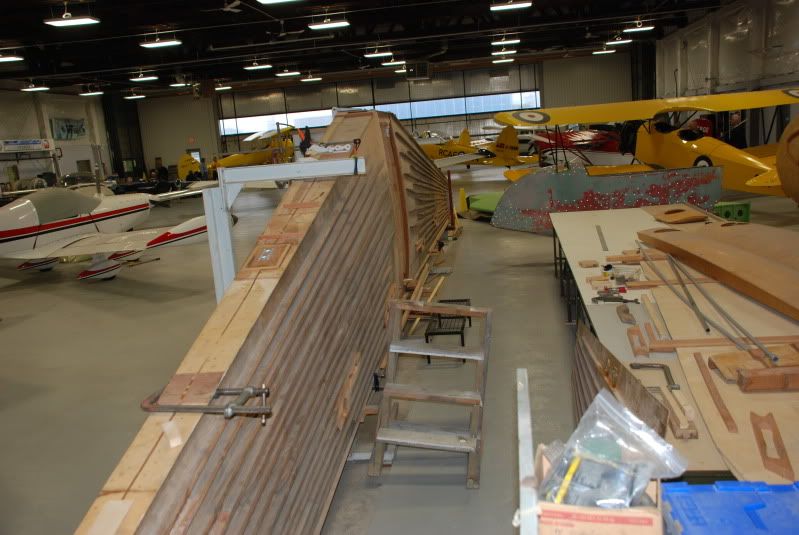
Just to illustrate the point about the Mosquito's wing and wood structure, here are some recent photos of the Canadian restoration in Windsor Ont . The fuselage was built in New Zealand, while the wing has been built in Canada.
MRP



MRP
Re: 633 squadron w/ cliff robertson on history channel tonight!!
Tue Nov 15, 2011 1:16 pm
TriangleP wrote:Robertson's character described himself as a barnstormer before the war, then he said he joined the Eagle Squadron when war started. There was nothing written in the script connecting his Mosquito flying to the Eagle Squadron. It's implied he's an American, a movie convenience for having a hard boiled American in the RAF.
Exactly so. Robertson's character in the book was British. Insert major American film star, get funding to make film...
Re: 633 squadron w/ cliff robertson on history channel tonight!!
Tue Nov 15, 2011 1:35 pm
dhfan wrote:TriangleP wrote:Robertson's character described himself as a barnstormer before the war, then he said he joined the Eagle Squadron when war started. There was nothing written in the script connecting his Mosquito flying to the Eagle Squadron. It's implied he's an American, a movie convenience for having a hard boiled American in the RAF.
Exactly so. Robertson's character in the book was British. Insert major American film star, get funding to make film...
Yep...Never let the facts get in the way of a good story.
Mudge the troubador
Re: 633 squadron w/ cliff robertson on history channel tonight!!
Tue Nov 15, 2011 3:04 pm
Just FYI as Tom Walsh pointed out in the Kidd Hofer post that 8 of the top ten aces came out of the RCAF who joined the USAAF 4th through the Eagle Squadrons. There were lots of Americans in the Canadian Air Force. The script is plausible.
Re: 633 squadron w/ cliff robertson on history channel tonight!!
Tue Nov 15, 2011 4:16 pm
IIRC wasn't there an American flying with 617 Sqn on the famous Dambuster Raid? Or at least there was one refered to in the 1954 film but not cast. Joe McCarthy was it? If true how much you want to bet that if Peter Jackson ever gets around to making his version, that his character will have major screen time to market for the US audience?
Re: 633 squadron w/ cliff robertson on history channel tonight!!
Tue Nov 15, 2011 6:28 pm
CH2Tdriver wrote: If true how much you want to bet that if Peter Jackson ever gets around to making his version, that his character will have major screen time to market for the US audience?
Today, US audiences will go see a UK film star...more than they would have in 1964. Remember, even then there were plenty of young non-American films stars that were big box office in the US...Peter O'Toole, Richard Burton, Sean Connery, Rod Taylor...but probably none were willing to do the film.
As fun as 633 Squadron is, it would be a comedown from Lawrence of Arabia, Cleopatra, James Bond, or The Birds
Re: 633 squadron w/ cliff robertson on history channel tonight!!
Tue Nov 15, 2011 6:54 pm
JohnB wrote:CH2Tdriver wrote: If true how much you want to bet that if Peter Jackson ever gets around to making his version, that his character will have major screen time to market for the US audience?
Today, US audiences will go see a UK film star...more than they would have in 1964. Remember, even then there were plenty of young non-American films stars that were big box office in the US...Peter O'Toole, Richard Burton, Sean Connery, Rod Taylor...but probably none were willing to do the film.
As fun as 633 Squadron is, it would be a comedown from Lawrence of Arabia, Cleopatra, James Bond, or The Birds
Like Murphy's War? (O'Toole, Grummans, not big box office.)
Re: 633 squadron w/ cliff robertson on history channel tonight!!
Tue Nov 15, 2011 7:36 pm
JDK wrote:Like Murphy's War? (O'Toole, Grummans, not big box office.)
You're comparing apples and oranges.
Murphy's War was circa 1973, a time when war films weren't too popular.
633 Squadron was in 1964, a different era for films and a time when war films were much more politically correct.
Besides, with Lawrence of Arabia in the recent past, Peter O'Toole was a bigger star in 1964. His appearance in the film would have lifted 633 Squardon from the ranks of "just another gung-ho" war film, which it certainly was.