Re: EF-82B to go on display in full night fighter configuration
Fri Feb 26, 2010 10:53 am
There are some of us CAFers who were not happy when they decided to paint the P-82 black. Even way back then, there were some who were wanting to see the planes painted as they were during their service days, or at least like a better known one of the same make and type.
I understand the NMUSAF wanting to have it represent a unique model of F-82, given that none exists, but I'd like to see a museum of their caliber represent history accurately.
I understand the NMUSAF wanting to have it represent a unique model of F-82, given that none exists, but I'd like to see a museum of their caliber represent history accurately.
Re: EF-82B to go on display in full night fighter configuration
Fri Feb 26, 2010 11:06 am
I think that this as close to a night fighter variant as we are going to see. They want to honor the men that flew these combat missions by creating as close as they can, their mount from Korea. This aircraft has no combat history and only served as a test bed aircraft for icing I think I read. She's been painted as a night fighter for the last 30 years and now it is going to get done all the way. I think it's going to be a sweet display.
I can understand painting aircraft in it's original paint scheme. That is the best route when there is a story to tell there or it is a historic airplane. But sometimes the airframe didn't do much and the restored aircraft can be used to represent and honor another aircraft. If it was a combat vet or something I'd be against it. This way an extinct example will be represented.
I can understand painting aircraft in it's original paint scheme. That is the best route when there is a story to tell there or it is a historic airplane. But sometimes the airframe didn't do much and the restored aircraft can be used to represent and honor another aircraft. If it was a combat vet or something I'd be against it. This way an extinct example will be represented.
Re: EF-82B to go on display in full night fighter configuration
Fri Feb 26, 2010 11:10 am
Rogue wrote:Dan K wrote:
Again, I confess to having mixed emotions over the NMUSAF converting the EF-82B into a P/F-82D. What's the point? The type never flew operationally with the USAF. Or are we supposed to squint past the Merlin cowlings and pretend it's a Korean vet?
Seems like since the have a newer model sitting outdoors they would use it.
But then again NMUSAF has a RP-63 also sitting outside at Lackland and try to pass off the one on the floor as a Pinball.
Just doesn't make good sense.

Look for that to change.
Re: EF-82B to go on display in full night fighter configuration
Fri Feb 26, 2010 11:16 am
Chris,
That would be wonderful!!!! Please keep us posted! (like I have to ask?)
That would be wonderful!!!! Please keep us posted! (like I have to ask?)
Re: EF-82B to go on display in full night fighter configuration
Fri Feb 26, 2010 11:34 am
Deleted.
Last edited by Second Air Force on Fri Feb 26, 2010 11:41 am, edited 1 time in total.
Re: EF-82B to go on display in full night fighter configuration
Fri Feb 26, 2010 11:37 am
I don't know, but will suggest it. I can't promise anyone will listen but I can send off a message.
Re: EF-82B to go on display in full night fighter configuration
Fri Feb 26, 2010 5:31 pm
In terms of understanding the NMUSAF's restoration/presentation decisions, here is one way to look at it. You first have to appreciate the context. The NMUSAF is an air force museum, not an aviation museum. It exists partly to preserve important artifacts but equally or more to narrate, celebrate, honor, propagandize (whichever word you prefer) a military service. It has a story to tell, an agenda. That agenda will sometimes conflict with strict preservation. A frequent source of such conflict in air force museums is the fact that due to the vagaries of survival, the artifacts on hand don't match the story that needs to be told. When this happens, there are some options:
1. Display the artifacts that you do have faithfully as themselves, explaining to visitors that though they don't quite fit the narrative, they are the closest available, and differ from the really appropriate artifacts in such-and-such way. Example: The RAFM Battle of Britain display needs a Bf 110 to tell its story, but the only one available is a night fighter from later in the war. The aircraft is restored faithfully as itself, with the fact that it is not perfectly representative of the 1940 day fighter explained with signage.
2. Display the artifacts that you have without major modifications, but tart them up with a paint job or other reversible measures to make them look like what you need to tell the story. Examples: Again from the RAFM BoB display, a Bolingbroke tarted up as a Blenheim; also numerous aircraft displayed at the NMUSAF and almost every other museum.
3. Modify the artifact so that it more or less represents what you need. Example: the NMUSAF pseudo B-25B; various Buchons converted to pseudo Bf 109s.
The decision depends on several things including the relative strengths of the museum's priorities (narrative vs. preservation), the rarity, significance and condition of the available artifact, and the intelligence and sophistication that is presumed of the audience. #1 assumes that the audience is intelligent enough to understand the reasons why surviving artifacts don't always tell the desired narrative perfectly, sophisticated enough to appreciate preserving artifacts as they originally were, and can make the mental leap to imagine how they contribute to the narrative anyway. #3 assumes a literal audience that needs as exact as possible a copy of the most appropriate artifact and doesn't mind irreversibly damaging the real artifact to get it. #2 is in between.
#2 is the most common method in almost all museums and seems a reasonable compromise. It misrepresents the artifact, but at least doesn't permanently damage it, and an enthusiast who doesn't care about the storytelling/honoring agenda can at least look past the paint and appreciate it for what it really is. I personally wish #1 was done more, and #3 almost never. The NMUSAF does #3 more often than most other major museums, and hardly ever #1, which creates some irritation from preservationists. But there is good reason to believe that the NMUSAF's core audience is much more wedded to the narrative than to preservation, so it's understandable.
It's not clear to me whether the proposed presentation of the CAF F-82 is a #2 or a #3. If they leave it as is but just hang a radar pod that can be removed some day and paint it black, it's #2. If they modify the noses etc. to represent another variant, that could be a #3. Considering that the airframe is rare, I hope they don't mess with it too much more than it already has been messed with.
August
1. Display the artifacts that you do have faithfully as themselves, explaining to visitors that though they don't quite fit the narrative, they are the closest available, and differ from the really appropriate artifacts in such-and-such way. Example: The RAFM Battle of Britain display needs a Bf 110 to tell its story, but the only one available is a night fighter from later in the war. The aircraft is restored faithfully as itself, with the fact that it is not perfectly representative of the 1940 day fighter explained with signage.
2. Display the artifacts that you have without major modifications, but tart them up with a paint job or other reversible measures to make them look like what you need to tell the story. Examples: Again from the RAFM BoB display, a Bolingbroke tarted up as a Blenheim; also numerous aircraft displayed at the NMUSAF and almost every other museum.
3. Modify the artifact so that it more or less represents what you need. Example: the NMUSAF pseudo B-25B; various Buchons converted to pseudo Bf 109s.
The decision depends on several things including the relative strengths of the museum's priorities (narrative vs. preservation), the rarity, significance and condition of the available artifact, and the intelligence and sophistication that is presumed of the audience. #1 assumes that the audience is intelligent enough to understand the reasons why surviving artifacts don't always tell the desired narrative perfectly, sophisticated enough to appreciate preserving artifacts as they originally were, and can make the mental leap to imagine how they contribute to the narrative anyway. #3 assumes a literal audience that needs as exact as possible a copy of the most appropriate artifact and doesn't mind irreversibly damaging the real artifact to get it. #2 is in between.
#2 is the most common method in almost all museums and seems a reasonable compromise. It misrepresents the artifact, but at least doesn't permanently damage it, and an enthusiast who doesn't care about the storytelling/honoring agenda can at least look past the paint and appreciate it for what it really is. I personally wish #1 was done more, and #3 almost never. The NMUSAF does #3 more often than most other major museums, and hardly ever #1, which creates some irritation from preservationists. But there is good reason to believe that the NMUSAF's core audience is much more wedded to the narrative than to preservation, so it's understandable.
It's not clear to me whether the proposed presentation of the CAF F-82 is a #2 or a #3. If they leave it as is but just hang a radar pod that can be removed some day and paint it black, it's #2. If they modify the noses etc. to represent another variant, that could be a #3. Considering that the airframe is rare, I hope they don't mess with it too much more than it already has been messed with.
August
Re: EF-82B to go on display in full night fighter configuration
Fri Feb 26, 2010 5:51 pm
I would say that the museum aims for #1, sometimes hits it sometimes doesn't and goes to #2. Almost never #3. And to put this in perspective almost all flying warbirds fall into #2 and alot of times #3 going by this standard.
Re: EF-82B to go on display in full night fighter configuration
Fri Feb 26, 2010 6:05 pm
I am also not sure what to feel about this. I see the point that says that paint it as what it is. Which is great for aircraft that are historic of course, but if we did that for every warbird flying, we would mainly have plain silver everything because many of them never actually saw combat. They are painted to honor the men that flew the type into combat. The B-25B at the NMUSAF doesn't bother me at all. For a few reasons. All work was done at North American and the difference between a D and a B is not too huge. On top of that the real crew from the aircraft it is painted as flew it to the museum. Doolittle and his crew delivered the aircraft to Dayton. That makes it pretty cool right there. It is currently the closest to a real raider out there on display. I hope that one day the B model in storage takes to the skies.
Currently there are zero night fighter P-82's on display. This example in question is hardly an unmolested aircraft and is not a very historic airframe. It has been operated in night fighter colors for many years, and the way I look at it is that now it is going to have that image that it has been standing in for many years taken all the way to display a full version of it. I think it would be cool to do this to the P-82 at Lackland, and then move the ex-CAF P-82 to another museum like Pima or NASM. But if the NMUSAF goes full night fighter with this P-82 it won't be the worst thing ever done to it either.
Currently there are zero night fighter P-82's on display. This example in question is hardly an unmolested aircraft and is not a very historic airframe. It has been operated in night fighter colors for many years, and the way I look at it is that now it is going to have that image that it has been standing in for many years taken all the way to display a full version of it. I think it would be cool to do this to the P-82 at Lackland, and then move the ex-CAF P-82 to another museum like Pima or NASM. But if the NMUSAF goes full night fighter with this P-82 it won't be the worst thing ever done to it either.
Re: EF-82B to go on display in full night fighter configuration
Fri Feb 26, 2010 6:17 pm
mustangdriver wrote:I think that this as close to a night fighter variant as we are going to see. They want to honor the men that flew these combat missions by creating as close as they can, their mount from Korea. This aircraft has no combat history and only served as a test bed aircraft for icing I think I read. She's been painted as a night fighter for the last 30 years and now it is going to get done all the way. I think it's going to be a sweet display.
I can understand painting aircraft in it's original paint scheme. That is the best route when there is a story to tell there or it is a historic airplane. But sometimes the airframe didn't do much and the restored aircraft can be used to represent and honor another aircraft. If it was a combat vet or something I'd be against it. This way an extinct example will be represented.
That was well said and you made me reconsider my opinions. When you continue on (in subsequent posts) and it sounds more like a defense of the museum I shake my head. But honestly, this was very well balanced and well written. August, as usual, makes some valid, well-thought points as well.
Re: EF-82B to go on display in full night fighter configuration
Fri Feb 26, 2010 6:35 pm
Chris, I'm hard pressed to think of a single case where the NMUSAF has chosen #1. Remember, this issue only arises where the artifact on hand is not the perfect one to represent the story. Memphis Belle etc. don't count; where the artifact that happens to survive is also just the one you would want to have, there is no decision to be made.
So which aircraft at NASM is in its own original configuration and markings that are inappropriate for the NASM's intended narrative, e.g. some boring stateside reserve aircraft or from a country/theater not central to the museum narrative? There used to be more, like the P-63, but the only one I can think of right now from the WWII era is the Ju 88.
You're quite correct that most flying warbirds are #2s or #3s, and you might even create a large #4 category for configurations and paint schemes that represent nothing historical at all. I don't see why that's relevant, though. Even though I've stated my preference, I'm not saying that #2 or #3 is bad. It's just what the NMUSAF does because of who it serves. I'm just offering a way to understand why it makes sense.
I generally agree with you about the B-25, but mainly because the artifact wasn't very rare; I don't care where the mods were done or about any of the Doolittle stuff. I also agree that the CAF F-82 is a heavily compromised artifact already. But I would still be sorry to see Allisons hung on it, and delighted to see it presented as what it really is. But that's just me.
August
So which aircraft at NASM is in its own original configuration and markings that are inappropriate for the NASM's intended narrative, e.g. some boring stateside reserve aircraft or from a country/theater not central to the museum narrative? There used to be more, like the P-63, but the only one I can think of right now from the WWII era is the Ju 88.
You're quite correct that most flying warbirds are #2s or #3s, and you might even create a large #4 category for configurations and paint schemes that represent nothing historical at all. I don't see why that's relevant, though. Even though I've stated my preference, I'm not saying that #2 or #3 is bad. It's just what the NMUSAF does because of who it serves. I'm just offering a way to understand why it makes sense.
I generally agree with you about the B-25, but mainly because the artifact wasn't very rare; I don't care where the mods were done or about any of the Doolittle stuff. I also agree that the CAF F-82 is a heavily compromised artifact already. But I would still be sorry to see Allisons hung on it, and delighted to see it presented as what it really is. But that's just me.
August
Re: EF-82B to go on display in full night fighter configuration
Fri Feb 26, 2010 6:39 pm
Thanks Ken, and yes sometimes I am a little defensive on the NMUSAF. As far as August's post, yeah it is a great post. I also am thankful to everyone that we have been able to talk about this restoration, and in a very constructive and positive manner. I have learned more about the twin Mustang in this thread than I ever knew.
Re: EF-82B to go on display in full night fighter configuration
Fri Feb 26, 2010 6:45 pm
August, I see what you mean now. Thanks for clearing that up. The reason I brought up flying examples is to try to show just what you said that there is nothing really wrong with any of these.
Re: EF-82B to go on display in full night fighter configuration
Fri Feb 26, 2010 8:50 pm
Yes, it's interesting to look at how different museums handle this problem. Like in the 1970s and 1980s when museums all wanted 109s but only Buchons were available. The Canadian NAM went with #1, posing a Spanish marked Buchon next to the Spitfire; USAFM went with #3, converting to a pseudo 109G. The CNAM probably had thousands of visitors over the years wonder what the Buchon was, what those yellow and red roundels were for, and what it had to do with the WWII ETO. USAFM visitors weren't so puzzled, but most of them thought they were looking at a 109 when they weren't. The USAF's exhibit made more sense but the Canadian one kept its integrity as an artifact. Both museums realized that their solutions weren't satisfactory and obtained real veteran 109s, restored in their own markings, when they could.
August
August
Re: EF-82B to go on display in full night fighter configuration
Fri Feb 26, 2010 9:50 pm
Thought maybe some of you would like to see a couple of photos of F-82B, 44-65162 prior to going to the CAF.
Photos taken at Lackland AFB, TX, circa 1956-1957 by Vince Reynolds. Sorry for the qualify but these were scanned from duplicate Ansco slides. Enjoy. John

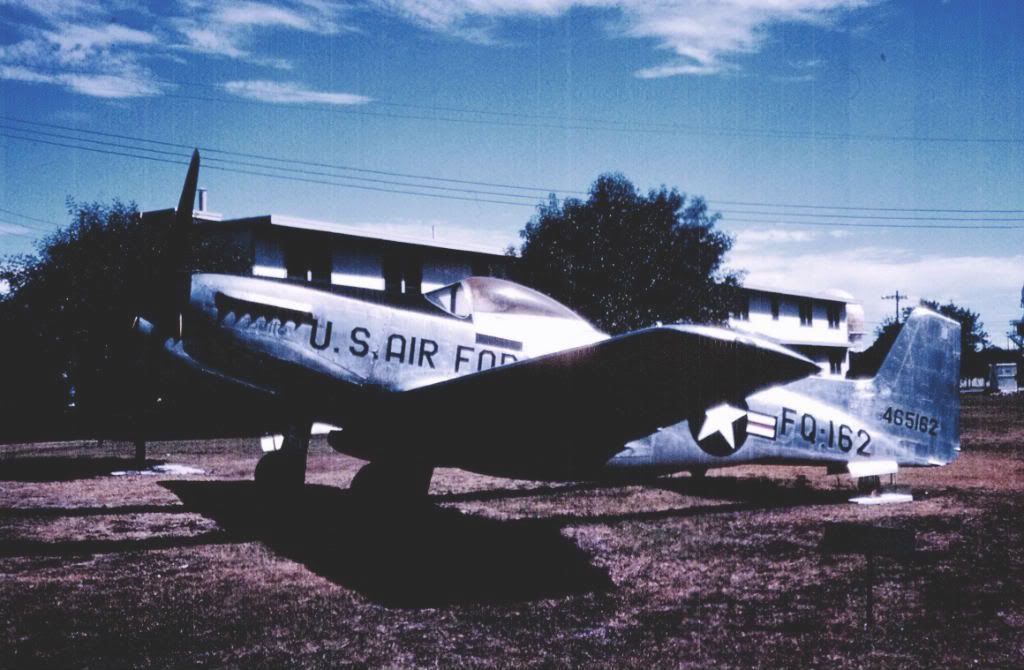
Photos taken at Lackland AFB, TX, circa 1956-1957 by Vince Reynolds. Sorry for the qualify but these were scanned from duplicate Ansco slides. Enjoy. John