Re: SWAMP GHOST
Wed Feb 03, 2010 9:35 am
JDK wrote:Experimental category B-17?
Point of reply, please?
Re: SWAMP GHOST
Wed Feb 03, 2010 9:52 am
airnutz wrote:JDK wrote:Experimental category B-17?
Point of reply, please?
Just asking, how would a B-17 fit in the experimental category? And then rides?
Regards,
Re: SWAMP GHOST
Wed Feb 03, 2010 10:14 am
JDK wrote:airnutz wrote:JDK wrote:Experimental category B-17?
Point of reply, please?
Just asking, how would a B-17 fit in the experimental category? And then rides?
Regards,
The same way the Diemert Zeke did. Not possible in Canada...truck 'er to Texas. No rides, unless they're crew or non-paying
passengers.
Re: SWAMP GHOST
Wed Feb 03, 2010 10:29 am
This airplane is not mine to decide anything on, so everything I am typing is really just hot air.
If the plan is to go back to airworthy condition I doubt that there will be all that much of the original structure left at the end of the day. The cockpit enclosure turtledeck and vertical fin might be in relatively decent shape, but the rest of the airplane has been partially submerged. I've mentioned this in another thread and will do so again here. The wing spars are constructed of hollow aluminum tubing with many steel brackets and gussets bolted and riveted to the spar tubes. Here is an example of such a joint:
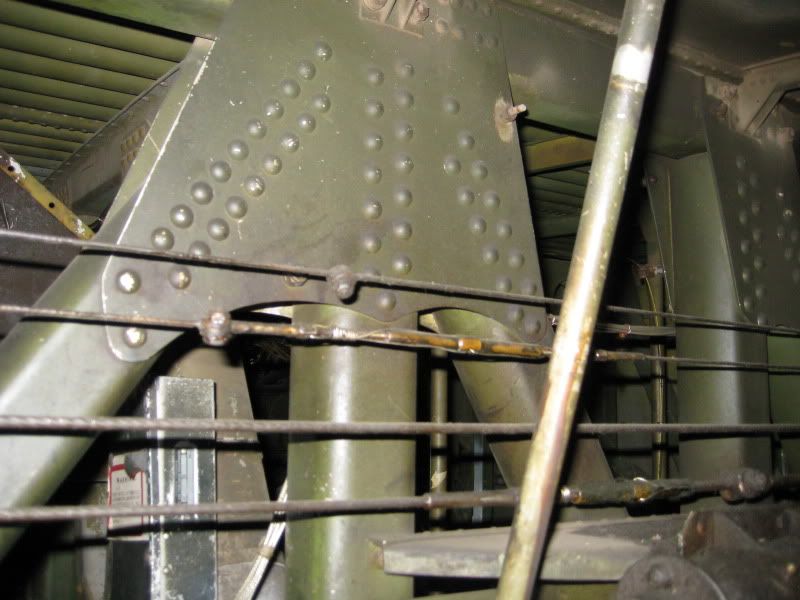
This particular gusset is aluminum, but the bracket you can't see on the front of the spar is steel. The conditions in the swamp would seem to be nearly perfect for the formation of corrosion in these members. The bomb bay carrythrough structure is built exactly the same way, with steel tubing in certain high stress areas. In addition, the wing skins between the forward and aft spars are a sandwich of corrugated and smooth skins riveted together. With all these dissimilar metals in a corrosive environment I would doubt that much of the wing or spar material could be reused in an airworthy machine. I hope that I'm wrong, but experience would seem to lead one to suspect problems.
I've wondered if the airplane wouldn't be appropriately displayed in some way at the Pacific Aviation Museum on Ford Island. After all, she flew patrols off Hawaii before heading to her final combat assignment.....
Scott
If the plan is to go back to airworthy condition I doubt that there will be all that much of the original structure left at the end of the day. The cockpit enclosure turtledeck and vertical fin might be in relatively decent shape, but the rest of the airplane has been partially submerged. I've mentioned this in another thread and will do so again here. The wing spars are constructed of hollow aluminum tubing with many steel brackets and gussets bolted and riveted to the spar tubes. Here is an example of such a joint:
This particular gusset is aluminum, but the bracket you can't see on the front of the spar is steel. The conditions in the swamp would seem to be nearly perfect for the formation of corrosion in these members. The bomb bay carrythrough structure is built exactly the same way, with steel tubing in certain high stress areas. In addition, the wing skins between the forward and aft spars are a sandwich of corrugated and smooth skins riveted together. With all these dissimilar metals in a corrosive environment I would doubt that much of the wing or spar material could be reused in an airworthy machine. I hope that I'm wrong, but experience would seem to lead one to suspect problems.
I've wondered if the airplane wouldn't be appropriately displayed in some way at the Pacific Aviation Museum on Ford Island. After all, she flew patrols off Hawaii before heading to her final combat assignment.....
Scott
Re: SWAMP GHOST
Wed Feb 03, 2010 12:56 pm
It is a tough dilemma for sure.
Does anyone have pics of My Gal Sal as a diorama? The only thing I've seen on their site are some old photos of the compartmentalized restoration. Nothing current that I could find.
I had forgotten or just hadn't seen the recovery photos from the swamp. Wow! Pretty amazing stuff.
Does anyone have pics of My Gal Sal as a diorama? The only thing I've seen on their site are some old photos of the compartmentalized restoration. Nothing current that I could find.
I had forgotten or just hadn't seen the recovery photos from the swamp. Wow! Pretty amazing stuff.
Re: SWAMP GHOST
Wed Feb 03, 2010 1:05 pm
I was there about a year ago. There are some pics on my flickr page in the aircraft section. The building is being planned for it, and the local government has just recently decided to support the project. Right now it is restored, and just waiting to go on display.
Re: SWAMP GHOST
Wed Feb 03, 2010 1:46 pm
James, for the purposes of argument...JDK wrote:Again there's a difference between 'museum quality conservation' which has the aim of slowing aging and decay as much as possible while retaining as much as possible of the original artefact, as against an airworthy restoration which has to have all parts certified to an airworthy standard - currently that means multiple parts are replaced. For airworthy restorations currently parts have to be replaced for certification issues not aging issues - thus many original parts cannot be re-used in a flyer.
What do you mean by certified? There are airworthiness directives that need to be complied with which deal with some very specific areas, but everything else is on conditional inspection. A corroded spar can certainly be replaced, but it could also be spliced per the structural repair manual (or on an FAA Form 337). Scratches, gouges and corrosion can also be simply blended out if sufficient material remains. Damaged holes are routinely repaired using oversized fasteners or bushings.
Although licensed as experimental, Stephen Grey's P-38 has significant main spar corrosion that was blended out and blessed by a structural engineer (Bruce Boland). I'm sure part of the calculation was the reduced gross weight a civilian owned aircraft would be operated at.
Please don't assume (not directed specifically at JDK) that just because polished new build Mustangs and Spitfires are rolled under a data plate that all-new is a requirement. It is a choice. My T-6 project has some dents. I can either replace the metal to make it look perfect or I can just accept the dent as-is as long as it meets the minimum structural criteria.
SG received corrosion from sitting in a swamp for XX years. If your goal is to "preserve" the aircraft as recovered, that is one thing- hose it down with ACF-50 and call it a day. If your goal is to display it as it was on its last mission, the corrosion should be removed and original combat repairs retained. Do you repair a corroded bulkhead in this case or replace it? I don't know! One could also present it as if it just rolled off the assembly line at which point it would be essentially a newly built aircraft.
I'm sure whoever the restorer is will put considerable thought into this lest a portion of the significant investment made will be squandered.
Re: SWAMP GHOST
Wed Feb 03, 2010 5:17 pm
bdk wrote:What do you mean by certified?
Basically what you've said, of course.
 For an airworthy restoration, it has to be inspected and signed of (piece/s of paper with an authorised signature - a certificate) that the aircraft is airworthy - this is broken down into more detail, as we both know. For a conservation job, the structural requirements are much lower, as I outlined below and the 'investment' (to use your word) is in retaining as much as is possible of the artefact for its future.
To put it another way - any airworthy restoration will junk more of an artefact's original parts than a static conservation, because the airworthy structural requirement is tighter.
One of my sub-points is an element of that is (probably) airworthy parts may and often are replaced because they don't have a paper saying they are airworthy, and it is not cost effective in the restoration process (owner's decision) to either NDT or repair them. Off the shelf replacement, which for a common type like the B-17, is easier.
There is a trend to retaining more original and more restored original material in modern restorations - A Good Thing. However it adds time, complexity and cost to an already exponentially more costly restoration.
If I had a cent for every conversation I've had with a restorer that assures me 'we are not compromising in any way' and then goes on to list all the 'logical' changes, and deviations, and replacements that are perfectly reasonable to that restorer - working only to an airworthy, not historic requirement - I'd have at least ~ well ~ a dollar.

This is where a national level collection's objectives and methodology differ utterly from that of any airworthy restoration.
I'm not suggesting all flying aircraft are 'dataplate specials'. Some fighters are, most heavies, that haven't been restored from wrecks, aren't. However flying aircraft are almost always less original than static. Sometimes in major ways, such as our beloved Ol 927, which both diverges from an A Model Liberator and has significant changes (engines) and post service 'new' material - itself sometimes replacing a replacement.
Scratches, gouges and corrosion can also be simply blended out if sufficient material remains. Damaged holes are routinely repaired using oversized fasteners or bushings.
All of which is an individually minor and cumulatively major step away from the originality of the whole aircraft. Not a major issue, but a dilution of the authenticity of the object. In the case of swamp ghost, would you 'restore' the engines and blowers? Or obtain and use other examples - exactly the same except lacking the actual details of the real engines on that aircraft - which as we know from (equivalent) colour scheme conversations - the devil is in the details for researchers.
Does this matter? On WIX, generally, no. However a recent thread asked about the types of rivets used on the F6F Hellcat. If I want to know exactly how Supermarine or Castle Bromwich put in a row of rivets on a Spitfire (for a thesis on engineering standards in W.W.II Britain, for instance) rather than how Historic Flying or Dick Melton did in the 1980 and 90s, I'm going to be looking at a static example, one of the Spitfires preserved unrestored but conserved in a national collection.
In art history, generally dealing with time periods for Renaissance art (my wife's speciality) much longer than aviation, 'restoration' is often a dirty word. We don't want to have to peer through the well intentioned by inappropriate work of people who thought they knew better than Leonardo in the 17, 18, 19 and even 20th century at his paintings - but we do. A perfectly 'restored' Mona Lisa would be a joke. Looking at aviation on that timescale, the more irreversible 'restorations' we carry out so we can get a thrill watching an aeroplane fly (for however long - but probably not 400+ years) is, ultimately a short term thrill over a long term historic gift.
So what? Well, we (already) have significant arguments over items like Lozenge camouflage from W.W.I German aircraft due in part to over enthusiastic, well intentioned but compromised 'restorers' work in the last century which has lost us most original data for 'pretty' looking aeroplanes.
Just some thoughts.
Regards,
Re: SWAMP GHOST
Wed Feb 03, 2010 6:49 pm
James (and perhaps a question for your wife), straying dangerously off topic, is that painting that the lady tripped and put her hand through any less valuable once restored and put back on display? Cerainly the situation is undesirable, but once it has happened, how significantly has the value been affected?
Re: SWAMP GHOST
Wed Feb 03, 2010 7:15 pm
I'm not familiar with that example, but generally repairs can be done to a very high standard - the interesting bit is current theory is to replace missing areas with a neutral fill, rather than trying to replicate the missing bit. This is often seen in frescoes and re-assembled pots. Many 'great' paintings have had a hard life - cut out of frames by thieves, paint coming away from the canvas and so on. That's why art conservation is such a tricky job.
Value - Historical value, if there's been damage that destroys part, the historical value ('utility for research & understanding' if you like) goes down. Cash value? Usually predicated on other factors like the status of the artist and number of available works. It might drop in the cash-ranking pecking order, but if it's a particularly highly rated piece, I'd suspect not.
The absurdity of value by cash only is shown in that the most expensive piece ('valuable' - to some) of art currently is a Giacometti sculpture. While I like and share a name with the guy, no one would seriously suggest he's the most important artist in history or art. It's just what someone wanted to pay for owning the piece, and a bank was no-doubt delighted to sell it at.
P-51D Mustangs - Giacomettis of the warbird world?
http://www.guardian.co.uk/artanddesign/ ... ion-record
Regards
Value - Historical value, if there's been damage that destroys part, the historical value ('utility for research & understanding' if you like) goes down. Cash value? Usually predicated on other factors like the status of the artist and number of available works. It might drop in the cash-ranking pecking order, but if it's a particularly highly rated piece, I'd suspect not.
The absurdity of value by cash only is shown in that the most expensive piece ('valuable' - to some) of art currently is a Giacometti sculpture. While I like and share a name with the guy, no one would seriously suggest he's the most important artist in history or art. It's just what someone wanted to pay for owning the piece, and a bank was no-doubt delighted to sell it at.
P-51D Mustangs - Giacomettis of the warbird world?
http://www.guardian.co.uk/artanddesign/ ... ion-record
Regards
Re: SWAMP GHOST
Thu Feb 04, 2010 12:31 am
JDK wrote:I'm not familiar with that example, but generally repairs can be done to a very high standard...
Here is the reference to the recently damaged painting:
New York (CNN) -- The Pablo Picasso painting "The Actor" will undergo repair work, after a woman visiting the Metropolitan Museum of Art fell onto the painting and tore the canvas, according to the museum.
The museum said the Picasso work was damaged Friday when a visitor lost her balance and fell onto the unusually large 6-foot, 4-inch work.
The six-inch tear is on the lower right-hand corner of the painting, the museum said in a news release Sunday.
The museum did not provide details of the incident beyond saying the visitor fell onto the painting. Repair work should be "unobtrusive," the museum said.
The painting should be ready in time for the late April exhibition of 250 works by Picasso, the museum said.
The painting marked Picasso's move from his "Blue period" to his "Rose period," when his creations showcased costumed acrobats reminiscent of characters in Italian comedy stage plays, according to the museum.
http://www.cnn.com/2010/US/01/24/picass ... index.html
Re: SWAMP GHOST
Thu Feb 04, 2010 1:04 am
Thanks! Damage to paintings (given their long lives) happens a lot more than people realise. It'll add to the provenance of the painting (another 'witness mark' to the history to confound fakes) but I don't think it'll have any effect on the painting's value/s.
But then, I'm not an expert on Picasso nor art valuation!
But then, I'm not an expert on Picasso nor art valuation!
Re: SWAMP GHOST
Sat Feb 06, 2010 5:11 pm
Even though I joined WIX in late 2007, I did not start posting and reading until yesterday (in the middle of the ongoing blizzard) so I'm a little behind.
What U.S. port will Swamp Ghost being taken to and where will she go from there?
As for what should be done with her.........she should fly. Shoo Shoo Shoo Baby was restored just 30 miles from my house (I was a kid then) and I got to see it during the 1983 Dover AFB Open House. Even back then I thought it was a tragedy to put so much effort into the restoration and then stick in a museum.
Chappie
What U.S. port will Swamp Ghost being taken to and where will she go from there?
As for what should be done with her.........she should fly. Shoo Shoo Shoo Baby was restored just 30 miles from my house (I was a kid then) and I got to see it during the 1983 Dover AFB Open House. Even back then I thought it was a tragedy to put so much effort into the restoration and then stick in a museum.
Chappie
Re: SWAMP GHOST
Sat Feb 06, 2010 5:14 pm
THat is exactly what needs to be done Chappie. Just because an aircraft is going to be restored to static, doesn't mean that corners should be cut.