Alaska B-24D crash (1943) (pics)
Thu Nov 15, 2007 11:12 pm
This is B-24D 41-23853. Most people today would only recognise this aircraft as the flat tin foil outline of a B-24 that has been used for target practice for several decades. These are pictures taken shortly after the crew's rescue by the salvage teams.
In 1943 Ladd Field was the home of the Army Cold Weather Test Station. Piloted by Maj. Ancil D. (Red) Baker. On Feb 4th 1943 853 aka "Gremlin's Delight", had been flying for 3 hrs observing and photographing a solar eclipse when the B-24 suffered the loss of engines No. 1 and No. 2. Inability to feather the props compounded problems and ultimately led to the aircraft crashing. All 14 aboard survived.
One week later another B-24D Ser No. 41-23873 with 1st. Lt. Clarence Hill at the controls took off from Ladd on 12 Feb. in the efforts to duplicate the events that led to the first crash, shutting down the 2 same engines and feathering and unfeathering the props. The exact sequence of events during that flight will never be known. But it was determined that Lt. Hill's B-24 was stalled and spinning when it impacted the ground. 7 men lost their lives.
Both crash sites lie on Fort Wainwright Military Reservation and lie in the remotest part of the North Star Borough.
Eventually the Cold Weather Test Lab found the reason for the feather pump failures. the oil in the feathering system was congealing in the freezing temperatures. The lab started experimenting with ways to keep the oil fluid and suceeded. However it was not before a 3rd B-24 crashed in 1943.
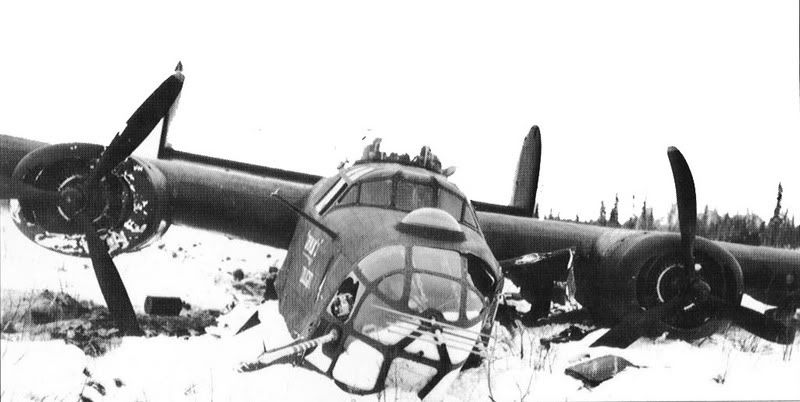

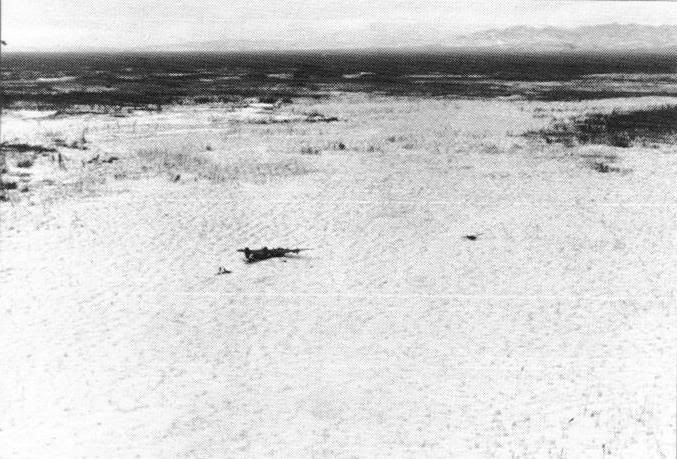
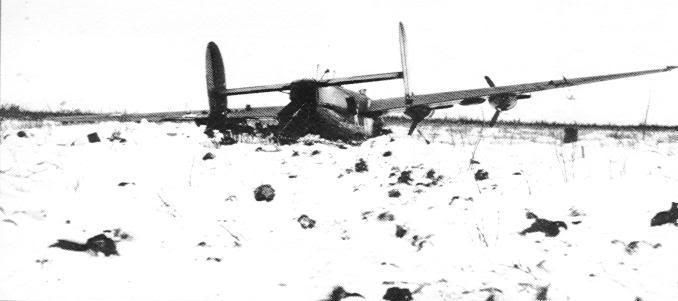
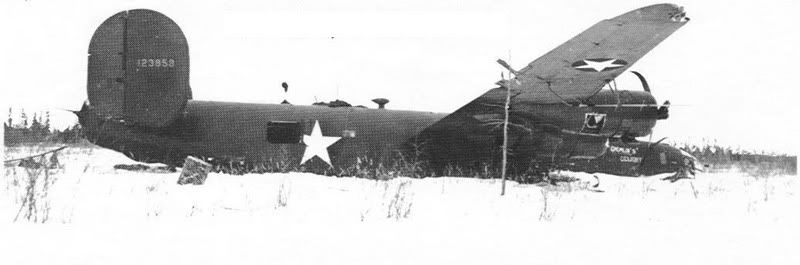
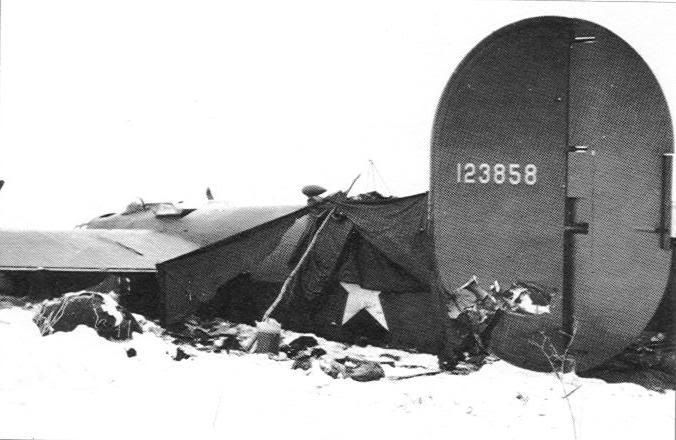
Too bad this one was used as a target. She would have made for a nice recovery.
Shay
____________
Semper Fortis
In 1943 Ladd Field was the home of the Army Cold Weather Test Station. Piloted by Maj. Ancil D. (Red) Baker. On Feb 4th 1943 853 aka "Gremlin's Delight", had been flying for 3 hrs observing and photographing a solar eclipse when the B-24 suffered the loss of engines No. 1 and No. 2. Inability to feather the props compounded problems and ultimately led to the aircraft crashing. All 14 aboard survived.
One week later another B-24D Ser No. 41-23873 with 1st. Lt. Clarence Hill at the controls took off from Ladd on 12 Feb. in the efforts to duplicate the events that led to the first crash, shutting down the 2 same engines and feathering and unfeathering the props. The exact sequence of events during that flight will never be known. But it was determined that Lt. Hill's B-24 was stalled and spinning when it impacted the ground. 7 men lost their lives.
Both crash sites lie on Fort Wainwright Military Reservation and lie in the remotest part of the North Star Borough.
Eventually the Cold Weather Test Lab found the reason for the feather pump failures. the oil in the feathering system was congealing in the freezing temperatures. The lab started experimenting with ways to keep the oil fluid and suceeded. However it was not before a 3rd B-24 crashed in 1943.
Too bad this one was used as a target. She would have made for a nice recovery.
Shay
____________
Semper Fortis
B-24
Fri Nov 16, 2007 8:09 am
Interesting nose shot. Note the gun installed in the upper "apex" of the nose piece. Not usually there on all but the earliest D models.
Alaska B-24D crash (1943) (pics)
Fri Nov 16, 2007 12:19 pm
I ran across a similar problem with feather pumps in cold temps in a Beech 18 with Ham-Standard props one winter.We normally used 120W oil year round as we flew all over the country during the winter and it might be -20 degrees F in Minnesota and 90 degrees F in Arizona on the same day.Normally,if the temp was forecast to go below 25 degrees F overnight,we would dilute the oil with fuel via a factory installed system.We used a schedule that required increasing dilution times (with the engines running) for lowering temps.The final part of the procedure was to cycle the feather pumps twice to get diuted oil into the prop system.Sometimes it was difficult to prevent the props from feathering and sticking in feather due to the low viscosity of the diluted oil,but it made the engines possible to start in the morning and allowed for immediate lubrication on start.As the oil warmed up,the fuel evaporated and the viscosity returned to normal.It was advisable to clean the oil screen the first time or two that dilution was used in the winter.
I ran into the feather pump problem after we switched to Philips 20W-50 multi-viscosity oil one winter.There was no need to dilute the oil which lead to an unexpected problem.One 20 degree morning in Hagerstown,MD.,the engines started without a problem,but when I ran a feather check by pushing the feather buttons and watching for a drop in rpm then stopping the process with the feather pump circuit breaker,there was no rpm drop.The feather pumps would run,but it turned out that there was enough condensation in the oil tanks following the previous day's flying to block the inlet to the pump at the bottom of the feather sump with ice.
I had no way to heat the oil other than flying the airplane.I ended up flying from Hagerstown to Warrenton,VA.and on to Dover AFB before the oil was hot enough to melt the ice.I cycled the feather pumps a couple of times to remove the concentrated water from the sumps at Dover and made it a policy to cycle the feather pumps a couple of times prior to the last shutdown of the day in cold weather and had no further problems.
It was a calculated risk to fly the airplane without being sure that I could feather the props.Fortunately,the weather was good and the airplane was lightly loaded with engines that had been very reliable and a number of suitable airports were available in the area.It was a very uncomfortable time ,though until the oil warmed up.
I ran into the feather pump problem after we switched to Philips 20W-50 multi-viscosity oil one winter.There was no need to dilute the oil which lead to an unexpected problem.One 20 degree morning in Hagerstown,MD.,the engines started without a problem,but when I ran a feather check by pushing the feather buttons and watching for a drop in rpm then stopping the process with the feather pump circuit breaker,there was no rpm drop.The feather pumps would run,but it turned out that there was enough condensation in the oil tanks following the previous day's flying to block the inlet to the pump at the bottom of the feather sump with ice.
I had no way to heat the oil other than flying the airplane.I ended up flying from Hagerstown to Warrenton,VA.and on to Dover AFB before the oil was hot enough to melt the ice.I cycled the feather pumps a couple of times to remove the concentrated water from the sumps at Dover and made it a policy to cycle the feather pumps a couple of times prior to the last shutdown of the day in cold weather and had no further problems.
It was a calculated risk to fly the airplane without being sure that I could feather the props.Fortunately,the weather was good and the airplane was lightly loaded with engines that had been very reliable and a number of suitable airports were available in the area.It was a very uncomfortable time ,though until the oil warmed up.