MiG-23 taxi test at LNC
Sat May 28, 2011 11:11 pm
MiG-23UB taxi test today went well including lighting the afterburner briefly.
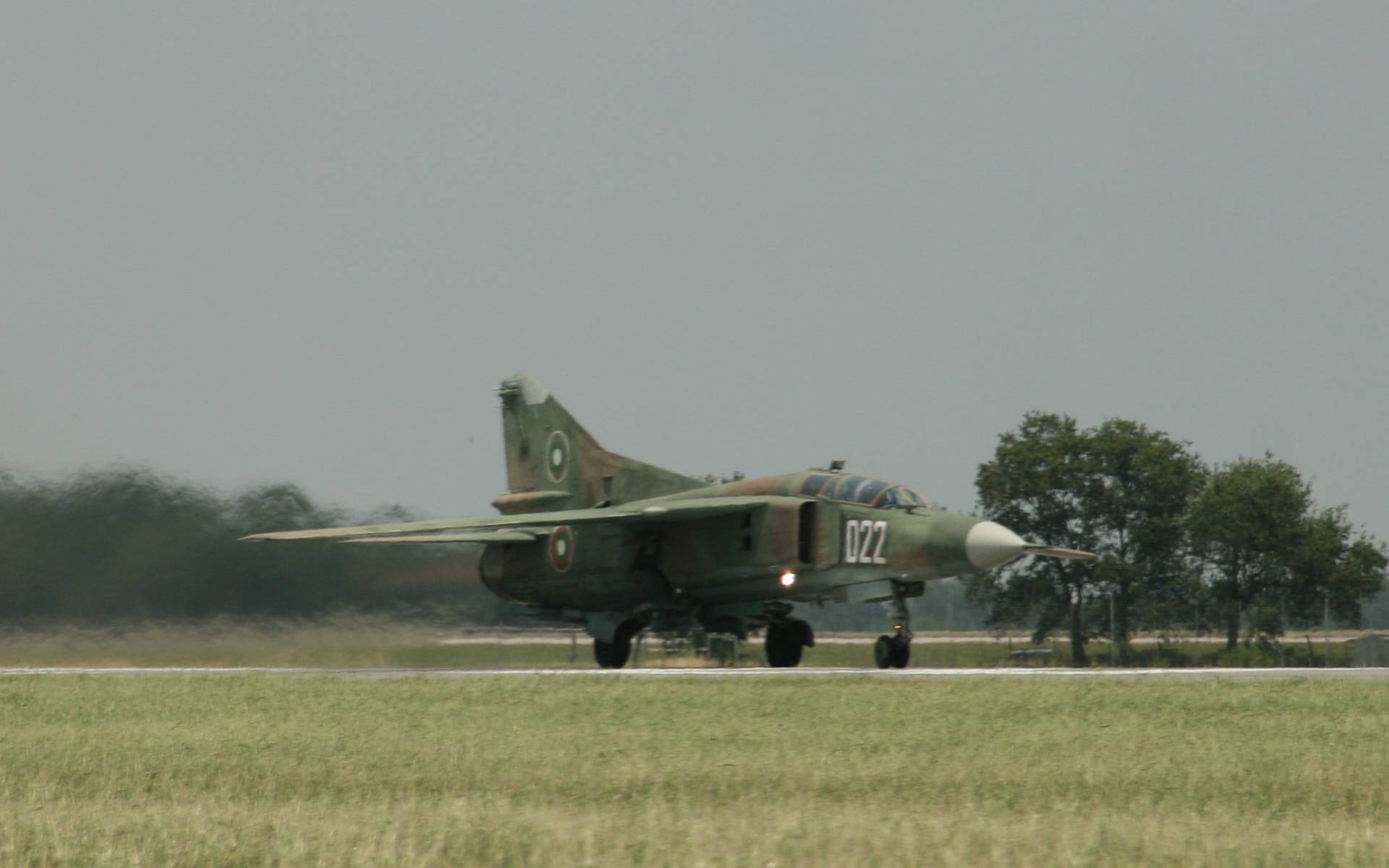
Re: MiG-23 taxi test at LNC
Sun May 29, 2011 12:33 am
Sweeet! Ear plugs anyone?
So is the new runway extension complete and will 6500 ft be enough to fly that beast? Long enough for the MiG-21 as well?
So is the new runway extension complete and will 6500 ft be enough to fly that beast? Long enough for the MiG-21 as well?
Re: MiG-23 taxi test at LNC
Sun May 29, 2011 6:07 am
that's awsome! so here's the question. are you bringing her to the Alliance airsow? i would LOVE to see a Mig 23. i've never seen one static or anthing.
Re: MiG-23 taxi test at LNC
Sun May 29, 2011 7:17 am
KLNC seems a little short for a Mig-23 to me as well.... that takeoff could be exciting, landing as well. USAF uses 8000' min... for a good reason... just sayin...
gunny
gunny
Re: MiG-23 taxi test at LNC
Sun May 29, 2011 8:58 am
gunnyperdue wrote:KLNC seems a little short for a Mig-23 to me as well.... that takeoff could be exciting, landing as well. USAF uses 8000' min... for a good reason... just sayin...
gunny
I wonder what the lenght of the runway was in the third world countries that the Mig flew out of? One can use Beltine Rd. extention with a hard left or right.....

Re: MiG-23 taxi test at LNC
Sun May 29, 2011 9:18 am
Gunny,
The 8000' normal minimum (which AFAIK is a USMC and USN thing too) is a brake saving thing more than anything. Below 8000 feet, they have to use the brakes a lot which wears them out quickly. Since none of the US's inventory uses drag chutes anymore, this further complicates the matter. Soviet designs are quite different. They are capable of operating from dirt strips, all have drag chutes, and the brakes are quite a bit beefier than most US designs of similar size (although not necessarily more effective).
I'm not saying that 6500' is short enough for the MiG-23, but I am saying that it's difficult to apply US procedures to Soviet aircraft because the design philosophy is much different.
The 8000' normal minimum (which AFAIK is a USMC and USN thing too) is a brake saving thing more than anything. Below 8000 feet, they have to use the brakes a lot which wears them out quickly. Since none of the US's inventory uses drag chutes anymore, this further complicates the matter. Soviet designs are quite different. They are capable of operating from dirt strips, all have drag chutes, and the brakes are quite a bit beefier than most US designs of similar size (although not necessarily more effective).
I'm not saying that 6500' is short enough for the MiG-23, but I am saying that it's difficult to apply US procedures to Soviet aircraft because the design philosophy is much different.
Re: MiG-23 taxi test at LNC
Tue May 31, 2011 9:27 am
I've seen some takeoff figures of 900 meters...3000 ft...on-line. Haven't seen any landing distances.
Doesn't the MIG-23 use blown flaps to increase short field performance as well as the variable-geo wing?
Doesn't the MIG-23 use blown flaps to increase short field performance as well as the variable-geo wing?
Re: MiG-23 taxi test at LNC
Tue May 31, 2011 12:54 pm
I seem to remember Jon or Roma someone saying something about blown flaps when I was given the walkaround of the plane as they unpacked it, but I can't remember for sure how it worked or anything like that.
Re: MiG-23 taxi test at LNC
Tue May 31, 2011 12:59 pm
Mmmm...that's just nasty looking. How about a Russian/Soviet Heritage flight? The CAF's I-16, somebody's Yak-3, a MiG-15, and this one?
Just sayin.....
Just sayin.....
Re: MiG-23 taxi test at LNC
Tue May 31, 2011 1:04 pm
CAPFlyer wrote:The 8000' normal minimum (which AFAIK is a USMC and USN thing too) is a brake saving thing more than anything. Below 8000 feet, they have to use the brakes a lot which wears them out quickly.
Are you talking about with the MiG-23 specifically, or in general terms across the services for fighters?
It's definitely not for "saving the brakes" in any of the USAF fast jets I've flown...
The fact is, it differs depending on the aircraft. In the Eagle, the issue was primarily brake heating on landing. In the T-38, it has way more to do with TOLD safety (and mostly with takeoff abort safety) than anything.
Re: MiG-23 taxi test at LNC
Tue May 31, 2011 2:33 pm
CAPFlyer wrote:Gunny,
The 8000' normal minimum (which AFAIK is a USMC and USN thing too) is a brake saving thing more than anything. Below 8000 feet, they have to use the brakes a lot which wears them out quickly. Since none of the US's inventory uses drag chutes anymore, this further complicates the matter. Soviet designs are quite different. They are capable of operating from dirt strips, all have drag chutes, and the brakes are quite a bit beefier than most US designs of similar size (although not necessarily more effective).
I'm not saying that 6500' is short enough for the MiG-23, but I am saying that it's difficult to apply US procedures to Soviet aircraft because the design philosophy is much different.
CapFlyer-
I agree with Hacker... it ain't about the saving the brakes.
Here's the skinny... it's about the takeoff and a possible abort. It doesn't matter who made the airplane... physics is physics. The Strike Eagle can get off in less than 3000' fully loaded... but it sure can't abort in that length. The takeoff data is computed to allow acceleration to a refusal speed... where you continue the takeoff or stop in the remaining runway... if you have two engines refusal speed becomes the speed at which you can loose an engine and continue the takeoff... or stop in the available runway. Brake heating has a direct impact on performance.... both in the aborted takeoff, and the landing. But max brake heating doesn't happen until approximately 30 min to an hour after the application. Steel brakes heat up to a fade point faster than modern carbon-carbon systems. Other than the airlines I've never had any official word, procedure or directive that spelled out "saving the brakes."
So, if you want to allow for the possibility that things can go horribly wrong during the takeoff and you might need to abort you have to take into account your weight, the speed when you start the braking and the distance required to stop. Note there is nothing in that equation about how much distance you have available to accel/stop. The pilot has to have the brains here and make that calculation.... if there isn't enough distance... you have to decide how important the takeoff is. And it just doesn't matter if it's Russian, Chinese, British or American manufacture.
Now the landing side of the coin. In the fighter business the USAF min runway length for non-barrier equipped runways is 8,000'. All USAF fighter runways use a Bak-12 or better barrier (read cable, much like the Navy Carrier system, but with different friction equipment). I've had 4 brake failures in the Eagle.... three of them on landing and I used the cable to stop... the 4th one happened when I taxied off the runway and the left brake disintegrated (5 carbon rotors and interleaved carbon pucks)... the right brake worked and the airplane just swerved a bit on stopping. The aerobrake is an effective means to slow down from landing speed (approximately 120 kts). The F-4 used a drag chute.... which was effective from landing ~140ish to 100ish kts.... then it was worthless... steel brakes.... long runways were good for rollout... to prevent overheating the brakes and the possibility of fade... which would mean you loose the ability to actually use the brakes for anything worthwhile. There is nothing about saving the brakes... other than preserving the ability to use them when it is important... note that carbon-carbon brakes are effective to outrageous temperatures (a good working temp is around 1000 degF).... the issue then becomes the heat transferred to the tires and possible fire.
Runway distance is important.... the interesting thing to note is how much the Mig-23 weighs and what kind of brakes it has. I'd bet they are plain steel brakes, with minimal anti-skid and the weight is close to 40k lb.... with the thrust in the .7 range.... it is very much like an F-4... but that swing wing tells you that it is a bit of a pig slow.... takeoff speed in the 140ish range.
My nickel is... Put all those together and 6500' is a bit on the short side to operate from... especially first flight. Let the Russians risk their necks for no good reason... in Russia. If these guys have a problem it reflects poorly on all warbird operators.... whether they live or not. How's that for design philosophy?
gunny
Re: MiG-23 taxi test at LNC
Tue May 31, 2011 6:42 pm
Wouldn't an adequate runway calculation be the distance to get to Vr + the distance to slow from Vr + some wiggle room (hopefully)?
Re: MiG-23 taxi test at LNC
Tue May 31, 2011 10:15 pm
I'm sorry guys, but I think we said the same thing in different ways. You both speak of brake failures and brake heat - this tends to be a usage issue, hence my original statement. I've had at least 4 F/A-18 pilots specifically state they don't like to operate on runways less than 8000 feet unless they have to because of the problems associated with heavy braking and the wear that comes from it even if they don't fail or overheat. That's what I was speaking too. I'm aware of TOLD issues, but again, that comes back to - 8000 feet puts you in a position where if something happens you can stop without (hopefully) risking failure during that abort.
As for the MiG-23, here's the specs:
MTOW: 39,749lbs
Typical Mission Weight: 34,612lbs (CWAM will probably operate somewhat below this)
Engine thrust in AB: 28,700lbf
Wing Loading: 78.6lb/f2
Thrust-to-Weight: 0.88
Also, here's a snippet from the "Pilot Report" from Dave Canavo on Delaware Jets -
The whole write-up can be found here - http://www.warbirdsofdelaware.com/Airpl ... fault.aspx
As for the MiG-23, here's the specs:
MTOW: 39,749lbs
Typical Mission Weight: 34,612lbs (CWAM will probably operate somewhat below this)
Engine thrust in AB: 28,700lbf
Wing Loading: 78.6lb/f2
Thrust-to-Weight: 0.88
Also, here's a snippet from the "Pilot Report" from Dave Canavo on Delaware Jets -
First solo landing accomplished in 5,500 feet of runway without drag chute or maximum effort.
The whole write-up can be found here - http://www.warbirdsofdelaware.com/Airpl ... fault.aspx
Re: MiG-23 taxi test at LNC
Wed Jun 01, 2011 4:09 pm
Listen in tonight on Warbird Radio.com when we talk to Jon Boede about the MIG-23 and the rest of the Cold War Air Museum warbirds.
Live at 8:00PM Eastern.
www.warbirdradio.com
Live at 8:00PM Eastern.
www.warbirdradio.com