Once again I ain't Jack, but I do have a few to share so here ya go......

USFG PHOTO
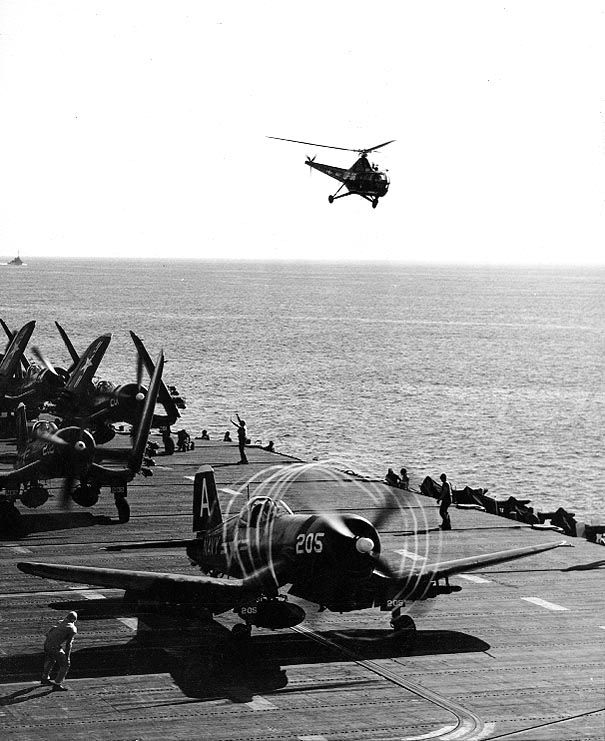
A Vought F4U-4 Corsairs of fighter squadron VF-791 Fighting Falcons launching from the U.S. aircraft carrier USS Boxer (CV-21) in 1951 during a deployment to Korea. The Sikorsky HO3S-1 plane guard helicopter of helicopter utility squadron HU-1 Det. F Pacific Fleet Angels is standing by.

USFG PHOTO
A Vought XF4U-3 Corsair in 1946.
Official Vought description of the XF4U-3: "In 1944 Vought converted 3 F4Us as test beds to test R-2800-18W and –16 engines equipped with high altitude turbo-superchargers. The R-2800-8 engine used in the basic Corsair had a two stage supercharger system. The objective of the proposed change to the turbo-supercharger system was to obtain greater speeds for the Corsair at higher altitudes. During evaluation tests in 1944, the turbo system proved to be faulty and cumbersome and though there was a measurable increase in speed in the 30,000 foot region the project was cancelled. Goodyear was to have built these high altitude turbo-supercharged aircraft as FG-3s. All three test aircraft were returned to the F4U-1 configuration. One of the XF4U-3 aircraft used to test the R-2800-16 engine is sometimes referred to as the XF4U-3B."
USFG PHOTO
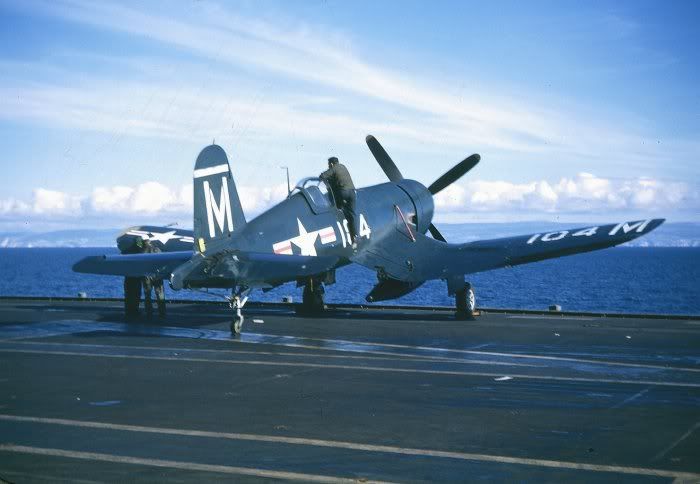
A U.S. Navy Vought F4U-4 Corsair of fighter squadron VF-1B, assigned to Carrier Air Group One (CVBG-1), aboard the aircraft carrier USS Midway (CVB-41). The Midway was on her first deployment from 29 October 1947 to 11 March 1948 to the Mediterranean Sea. VF-1B was redesignated VF-21 on 1 September 1948.

USFG PHOTO
Vought F-8E Crusader (BuNo 150328) of U.S. Marine Corps all weather fighter squadron VMF(AW)-235 at Da Nang, South Vietnam, in April 1966.
USFG PHOTO
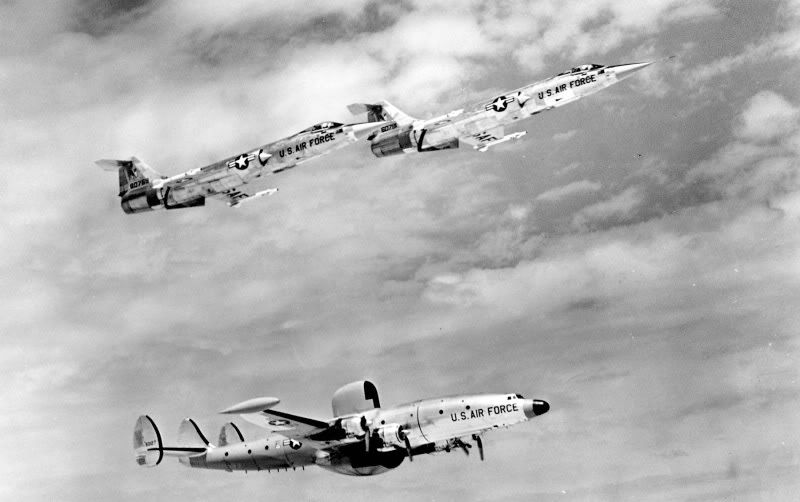
Two U.S. Air Force Lockheed F-104A-15-LO Starfighters (s/n 56-0769 and 56-0781) in flight with Lockheed RC-121D-LO Warning Star (s/n 55-0127), circa late 1950s or early 1960.
USFG PHOTO
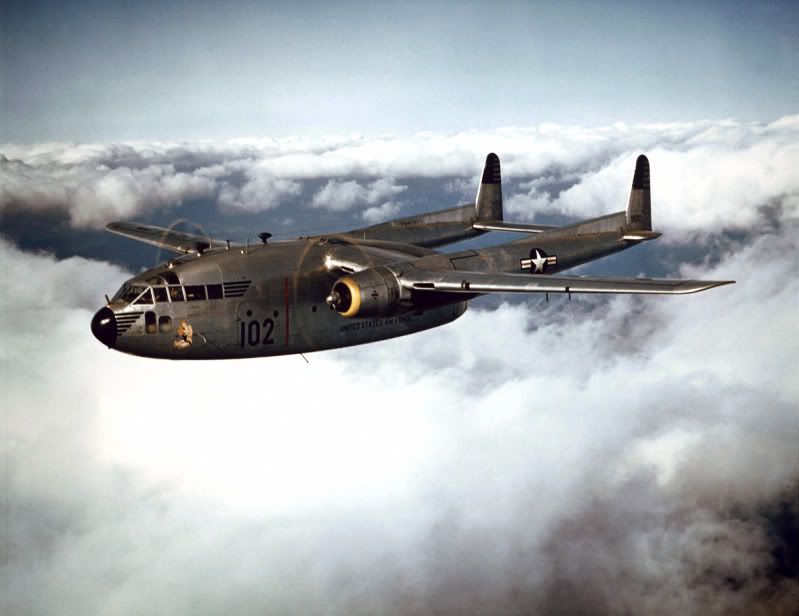
A U.S. Air Force Fairchild C-119B-10-FA Flying Boxcar of the 314th Troop Carrier Group in 1952. This aircraft (s/n 49-102) was later converted to an C-119C in 1955/56.
"The 314th Troop Carrier Group C-119 Flying Boxcars do not start out for the "mountain" unless weather reports are good. They must be able to see the tiny drop zone on the peak before they can drop. But weather is so unpredictable in the high mountains, that often when the planes arrive, the entire area is "socked in" with heavy clouds. In the radio contact with the "men on the mountains," the pilots circle hoping for a break in the clouds, or sometimes, to dive under the clouds and drop on the lower slopes. On several occasions, the planes have had to return to Japan as many as three times without dropping. But 314th Troop Carrier Group pilots are presistant, and eventually win through to drop successfully.
USFG PHOTO
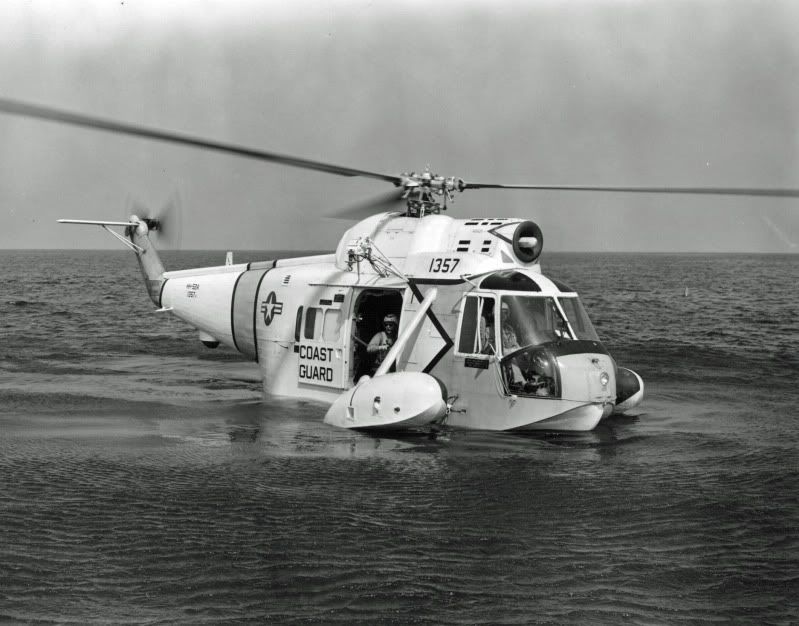
A U.S. Coast Guard Sikorsky HH-52A Seaguard helicopter (s/n 58-1357) demonstrates its ability to land on water on Lake Pontchartrain, Louisiana (USA), 23 September 1964.
USFG PHOTO
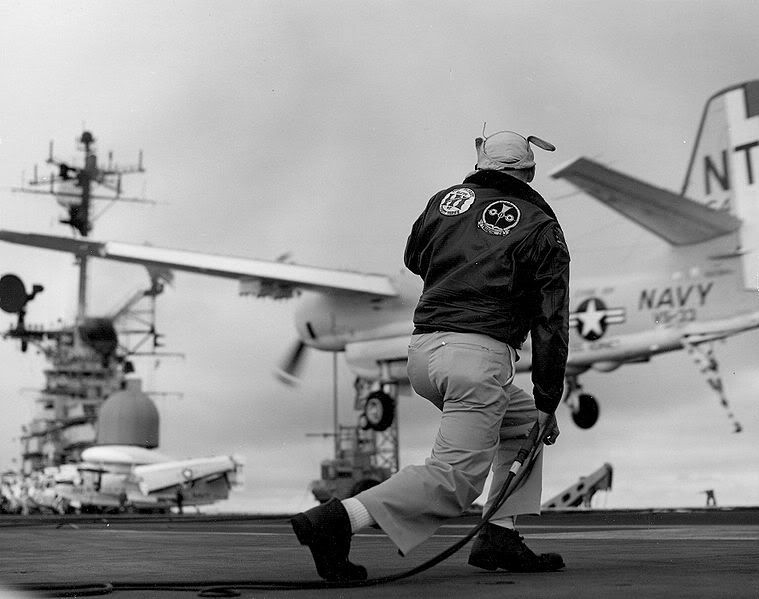
A U.S. Navy Grumman S-2E Tracker of antisubmarine squadron VS-33 Screwbirds, Carrier Anti-Submarine Air Group 59 (CVSG-59), passes by a Landing Signal Officer (LSO) on its way to trapping on board the aircraft carrier USS Hornet (CVS-12), in 1970.

USFG PHOTO
Air-to-air right side view of a U.S. Air Force 0-1E Bird Dog aircraft. The aircraft is used as a forward air control aircraft throughout South Vietnam. The forward air controller (FAC) spots suspected enemy strongholds and fires smoke rockets to mark the target for strike aircraft. Following a strike the FAC assesses bomb damage.

USFG PHOTO
RB-57 of the 363d Tactical Recon Group - Shaw AFB, SC .
Date January 1967(1967-01-01)

USFG PHOTO
Martin RB-57E -Patricia Lynn- 3-4 front view at Da Nang AB, South Vietnam, January 1960.

USFG/NASA PHOTO
NASA research pilot Bill Dana takes a moment to watch NASA's NB-52B cruise overhead after a research flight in the HL-10. On the left, John Reeves can be seen at the cockpit of the lifting body. The HL-10 was one of five lifting body designs flown at NASA's Dryden Flight Research Center, Edwards, California, from July 1966 to November 1975 to study and validate the concept of safely maneuvering and landing a low lift-over-drag vehicle designed for reentry from space. Northrop Corporation built the HL-10 and M2-F2, the first two of the fleet of "heavy" lifting bodies flown by NASA. The contract for construction of the HL-10 and the M2-F2 was .8 million. "HL" stands for horizontal landing, and "10" refers to the tenth design studied by engineers at NASA's Langley Research Center, Hampton, Va. After delivery to NASA in January 1966, the HL-10 made its first flight on December 22, 1966, with research pilot Bruce Peterson in the cockpit. Although an XLR-11 vehicle, the first 11 drop flights from the B-52 launch aircraft were powerless glide flights to assess handling qualities, stability, and control. In the end, the HL-10 was judged to be the best handling of the three original heavy- weight lifting bodies (M2-F2/F3, HL-10, X-24A). The HL-10 was flown 37 times during the lifting body research program and logged the highest altitude and fastest speed in the Lifting Body program. On February 18, 1970, Air Force test pilot Peter Hoag piloted the HL-10 to Mach 1.86 (1,228 mph). Nine days later, NASA pilot Bill Dana flew the vehicle to 90,030 feet, which became the highest altitude reached in the program. Some new and different lessons were learned through the successful flight testing of the HL-10.

USFG PHOTO
P-61 airplane in flight test with ramjet burning. The P-61 aircraft was built by Nothrop and used by the Aircraft Engine Research Laboratory or AERL of the NACA to test the new jet engine. The AERL is now NASA's John H. Glenn Research Center in Cleveland, Ohio. Date 27 January 1947.

USFG PHOTO
The F-80 Shooting Star, first introduced into the Test Pilot School curriculum in August 1947, allowed students to learn the unique characteristics of jet aircraft. Major Nathan Rosengarten, Chief, Air Technical Service Command Flight Research Branch, checks data with pilot Captain Conrad Nelson.

USFG PHOTO
Maj. John F. Bolt, the USMC's first "Jet Ace", in F-86, 1953: Seated in a U.S. Air Force F-86E "Sabre" jet fighter.
This plane is an F-86E-6, serial # 52-2852. Note pilot's name painted on the canopy frame, with victory stars and nickname "Darling Dottie" painted below. Photo is dated 13 July 1953, two days after Major Bolt shot down his fifth and sixth MiG-15s to become the only U.S. Marine Corps air "Ace" of the Korean War. He achieved the aerial victories while flying with the 5th Air Force as an exchange pilot.
The original caption states: "Major Bolt, who shot down six Japanese planes during World War II, has flown 89 jet fighter-bomber missions with the 1st Marine Aircraft Wing, which has been assigned only close support and interdiction missions in Korea. He has flown 37 Saberjet sweeps with the 5th Air Force, which is carrying the air war to the MiGs.

USFG PHOTO
Airmen of the 50th Field Maintence Squadron pose in front of one of their aircraft, North American F-86H-10-NH Sabre serial 53-1451 of the 417th Fighter-Bomber Squadron - Toul Air Base France, Summer 1956.

USFG PHOTO
USAF Majors [Bernard Fisher and D.W. "Jump" Myers, Vietnam. Photo taken after Fisher's rescue of Myers from the airfield in the A Shau Valley. Fisher was awarded the Medal of Honor for this action. Date 1966.



 Login
Login Register
 FAQ
FAQ Search