This is the place where the majority of the warbird (aircraft that have survived military service) discussions will take place. Specialized forums may be added in the new future
Post a reply

Question about warbird engines...

Sat Nov 05, 2011 11:40 pm

I know that the majority of R-2800 powered fighters still airworthy are powered by CB-16 engines...for reliability/safety sake. But I'm curious...how many Corsairs (or fighters in general) are flying with their original "fighter" engines? I know these engines needed overhaul much faster than their later replacements, but I also know that restorations are getting more and more authentic these days. Just curious. Thanks in advance!

Re: Question about warbird engines...

Sun Nov 06, 2011 1:23 am

Way back when Ray Anderson was still at Stockton he was working on an R2800 for a Corsair that John Lane was building for a customer. I had an original overhaul manual for the R2800-8W and -10W that he copied to rebuild the correct engine for the FG-1D. I was happy to have been able to help in a small way to see an original engine go back into a Corsair.

That is the engine that went into Gary Kose (sp) FG-1D that I later got to see up close at OSH in 2003.
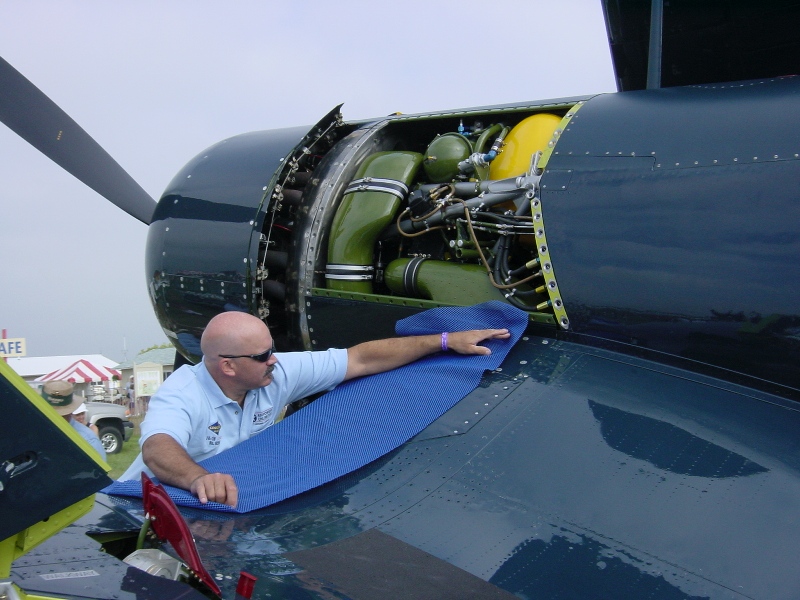
Image

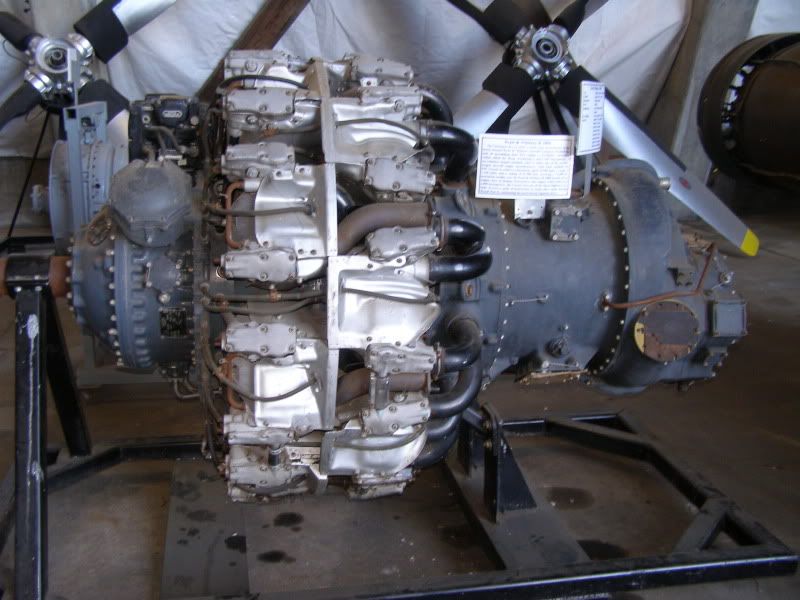
Notice all of the ducting for the inter coolers. The accy and blower section of this two stage two speed Pratt & Whitney masterpiece is something to behold. The air is compressed by the first stage and exits the engine to the inter cooler then its back in for the second stage of compression. The firewall forward or QEC is jammed full of ducting and accy/blower case. Nowadays most everyone uses CB's and it seems like they are about half the length of the -8W B series engine. With the CB in an FG-1D there is so much room between the firewall and the engine you could put a second seat in there!

The CB is 2500 HP and the -8W was 2200 or so?
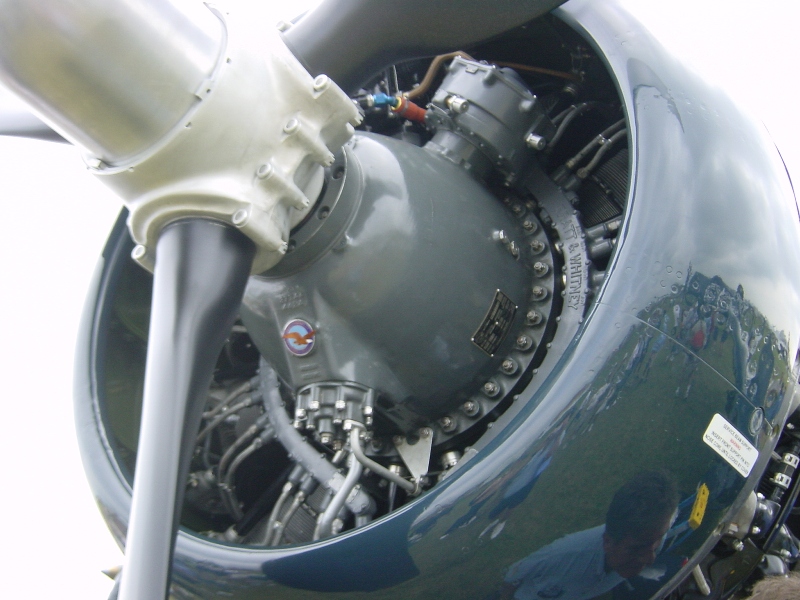
Image

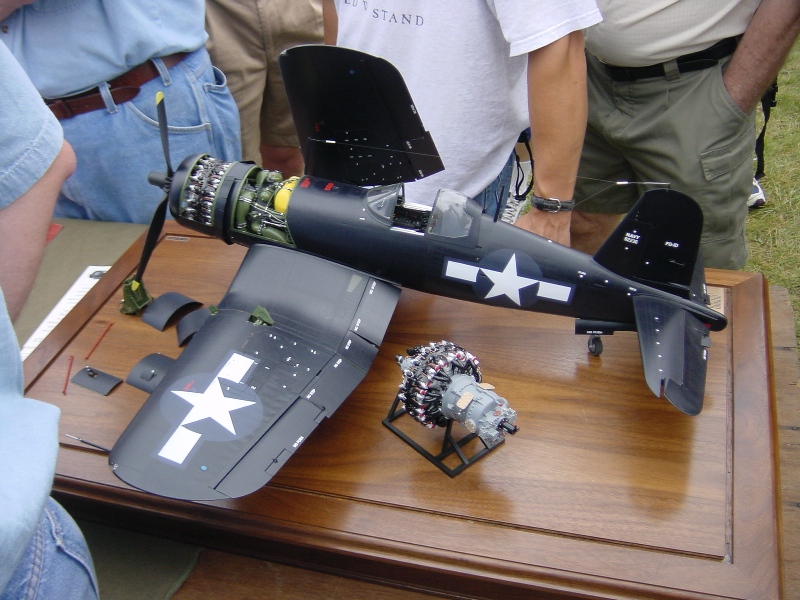
He even made a scaled nearly all metal FG-1D and an extra engine with such detail he even machined special studs and nuts for the engine.
Image

John Lane told me he took the FG-1D up to altitude and shifted the blower. He said it was a kick to fly and did great. Maybe he can elaborate on the details of an amazing restoration as it was, and is, awesome.

Ray Anderson of Anderson Airmotive in Grangeville, Idaho is an R2800 God and he builds all sorts of other wonderful engines too. As far as I know the one Ray built the only operational original full and complete -8W on a Corsair. I think Frank Arrufat's FG-1D has a -8W but as I recall they changed the blower.

I'm pretty sure that FHC's FG-1D 88303 will have an original -8W someday.

Any others?

Re: Question about warbird engines...

Sun Nov 06, 2011 9:47 am

This is just a WAG but I would say most Mustangs have the "transport" heads on the Merlin for longivity, and most R2800 operators have CB series engines. The bombers and transports use the original engines as do the trainers. As for the B-29, we would not be flying FIFI today without the more modern engines installed.

Re: Question about warbird engines...

Sun Nov 06, 2011 10:57 am

Thanks for the replies, guys! This thread was not meant to frown upon any restoration in any way! The more in the air, the merrier, I say! But I for one am continually blown away by all the restorations coming out with an emphasis on authenticity, and I was just curious about engine choices. The average passerby probably could not tell the difference, but I still think its neat...and an awesome trend! These aircraft are obviously not performing the same functions (flying the same altitudes) as when they were built, but somehow it's kinda cool to think that some of them still could.

Matt

Re: Question about warbird engines...

Sun Nov 06, 2011 1:39 pm

The Corsair had a 2 speed supercharger that was engaged by a simple single-throw switch, same as with the civilian variants.

The reason the Corsair engines are smaller is because most are actually CB3's not CB16's. The CB3 has a single speed supercharger which is smaller due to the lack of gearing. Some have CB16's modified to be CB3's (by disabling the high speed gearing and associated selecting actuator), but I think that's where most of the difference comes in. The big thing is that today there's no need for the high speed supercharger because no one cruises the Corsair or any other R2800 powered aircraft up at the altitudes (above ~18000 feet MSL) for any period of time where use of the high blower speed is needed. I know the Convairliners and DC-6 manuals show switching speeds around 14,000 feet, but there are "low speed" supercharger cruise settings tabled for up to 20,000 feet when running light. All the high supercharger speed did was raise the critical altitude of the engine, thus allowing it to provide rated cruise and climb power to a higher altitude, not actually provide any more overall power.

Also, I believe the Cavanaugh "FG-1C" has a military-plated R2800 on it still.

Re: Question about warbird engines...

Sun Nov 06, 2011 3:33 pm

Here is a shot of the 2800 B series engine accessory blower case.

Image
R-2800B by Cherry Bomb Photography, on Flickr

Image
Corsair R-2800 B Disassembly by Cherry Bomb Photography, on Flickr

Re: Question about warbird engines...

Sun Nov 06, 2011 3:46 pm

I may be wrong but It's not the two speed supercharger that makes the B series -8W and the -10W so long. Its the two stage supercharger that makes it really long because of the dual blowers.

From what I understand the clutch package on the CB-3 and the CB-16 is the basic difference in the two and it can be changed to convert one to another. Otherwise they are basically the same.

The WWII B series is a very different engine when compared to the CB.

You can see in the photos from cherrybomber the blower case is really long and you can see the round port where the air exits from the first stage blower and heads to the inter cooler.

Re: Question about warbird engines...

Mon Nov 07, 2011 8:18 am

Craig McBurneys corsair will fly with an original -18w which was standard equipment for the f4u-4.

Re: Question about warbird engines...

Mon Nov 07, 2011 12:41 pm

Taigh, thanks for that correction, you're right that the B-series has a 2 STAGE supercharger versus a 2 SPEED supercharger. They do the same thing in the end, but with 2 separate stages, when you enter the "High" Stage, you can either be engaging both supercharger stages together or switching between one and the other (I've heard of both being used on different planes) with one stage having a different gearing to produce the higher RPMs required to compress the thinner air.

The cockpit operation of the two and the effect on the engine is nearly identical though - there is a toggle switch or lever to change between stages/speeds and when you go into high stage/speed, you get more compressive capability for the thinner air at that altitude resulting in more power being available at a given altitude. My books don't say if there's any interlock/interconnect in the F4U to prevent the "High Stage" from being selected at too low of an altitude or if the High Stage has any overboost protection, but I know on the CB's and CA's you have to be very careful to not use high speed under 10,000 feet as it can quickly overboost the engine if something goes wrong and there's no protection from it doing so. The oddest thing in my time with Air Tahoma was that all our CB16's were essentially CB3's (had the CB16 clutch installed, but the shift wiring disconnected) and the only plane with the two speed still working had CA18's installed.

Re: Question about warbird engines...

Mon Nov 07, 2011 2:38 pm

as a quick aside, that model corsair is awesome by the way 8)

Re: Question about warbird engines...

Mon Nov 07, 2011 5:53 pm

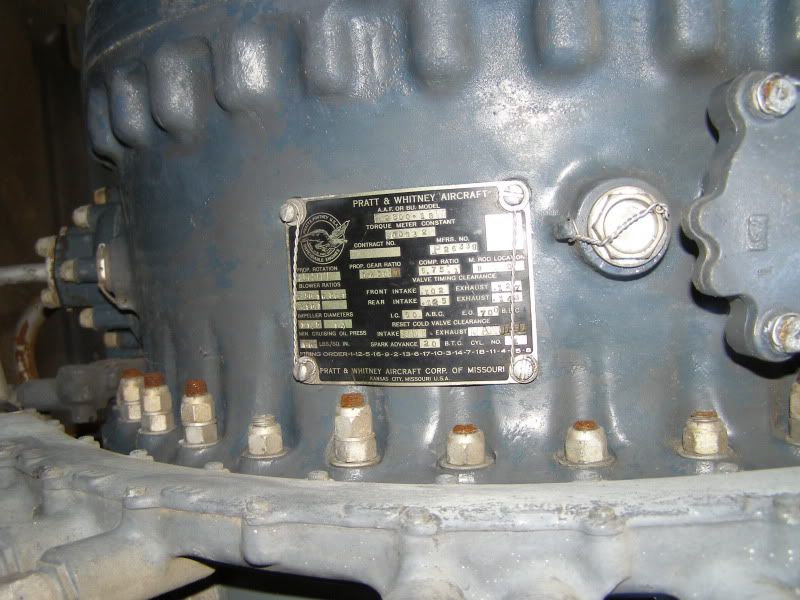
here's a couple of pics I took of a 2800-18 on display in Tilamook a few years back. It's amazing how long the accessory section is.
Image
Image

Re: Question about warbird engines...

Mon Nov 07, 2011 6:21 pm

Chris,

Like a beautiful lady without jewelry, it just wouldn't be right to send a sweet power section like that out the door without being properly accessorized!

b29flteng,

That most Mustangs are now flying with transport heads would not be accurate. There was a time when a lot of the Mustang operators were after the transport heads and switched over to them if they could get their hands on a good set. They are without question a stouter piece. However, at this point the remaining transport heads are all getting a lot of time on them and the prevailing thinking is coming full circle again. While the -7 and -9 heads are not as robust in some ways, a lot of them now have significantly less time on them and the time they do have on them can usually be counted on as being less abusive than the hard use the transports have seen either through true transport service or racing. In the end, at this point, 99 out of 100 Merlin heads whether transport or not are going to be cracked and need repair. That doesn’t make them junk it just means they need to be repaired. For the service most Mustang operators put their engines through these days any style of head will be sufficient provided it’s serviceable. Less time just means it should be more reliable in the long run but as in most things, there is no guarantee of that.

Radials drool while Merlin’s RULE! :lol:

John

Re: Question about warbird engines...

Mon Nov 07, 2011 7:48 pm

What would be the consequences of forgetting to disengage high gear while you were descending rapidly in a dive? I recently read 'Carrier Pilot' by Norman Hanson, who was a Royal Navy pilot who flew Corsairs with 1833 Sqn on board HMS Illustrious. He relates the story of how a young pilot who was converting to the Corsair was killed when he put the aircraft into a fast dive in high gear and the engine was blown clean off the airframe.

Could this really happen, and if so how frequent an occurrance was it?

Re: Question about warbird engines...

Mon Nov 07, 2011 8:44 pm

b29flteng wrote:This is just a WAG but I would say most Mustangs have the "transport" heads on the Merlin for longivity, and most R2800 operators have CB series engines. The bombers and transports use the original engines as do the trainers. As for the B-29, we would not be flying FIFI today without the more modern engines installed.


We're using R2000-7M2's now from DH Caribous. It has a fixed supercharger rather than the two speed one on the -4, -7 or -11 engines that were OEM on C-54's.

Re: Question about warbird engines...

Mon Nov 07, 2011 8:48 pm

Red Tail wrote:
Radials drool while Merlin’s RULE! :lol:

John


Blasphemy! :wink:
Post a reply