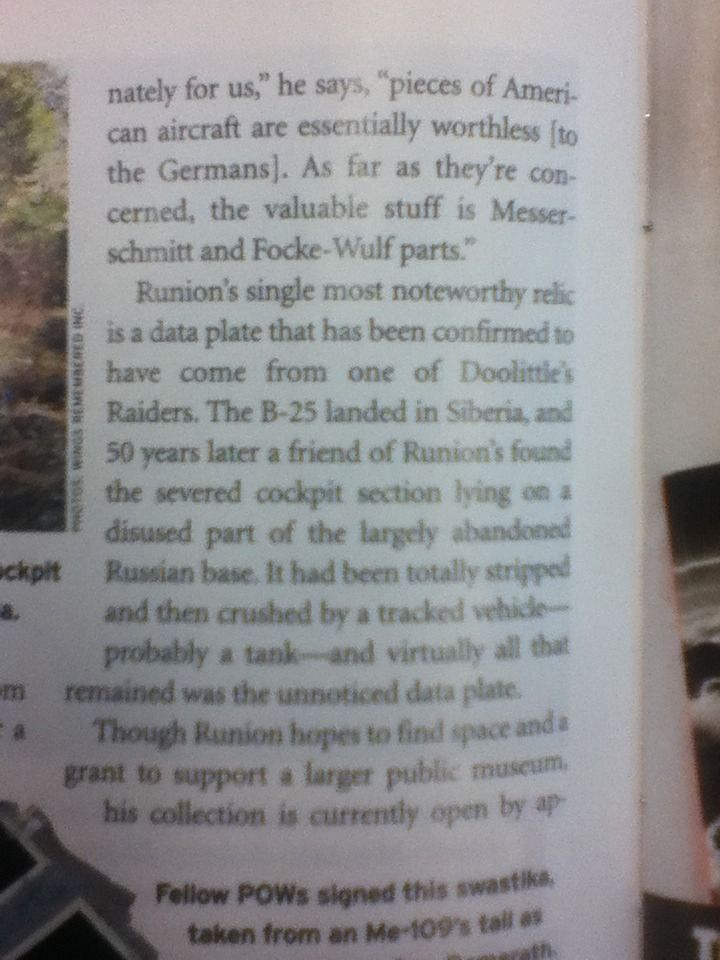
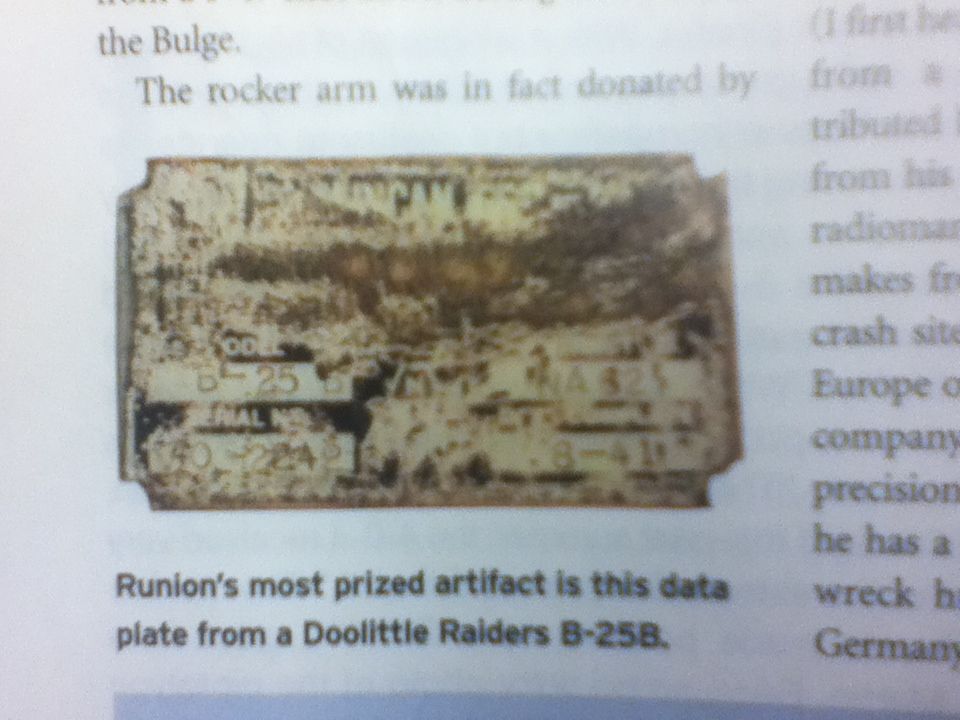
Charles Runion, the Tennessean who owns the collection of WWII artifacts of which that B-25 dataplate is now a part, told me that the remains of the B-25 were found by a friend of his during a business trip "some years ago" (I got the impression that it was the early 1990s) on "a Russian airbase." Runion was no more specific than that. He did say that his friend told him that all that remained of the Mitchell was the nose-and-cockpit section, and that it appeared to have been crushed pretty much semi-flat by some kind of tracked vehicle, whether that was a piece of construction equipment or a tank wasn't known. What remained had been picked clean of things like instruments, accessories, controls, etc. and that literally all that remained was the structure and the dataplate.
I've seen a photograph of the dataplate (reproduced in my article), and it certainly looks entirely original to my untrained eyes.
Runion is -not- a historian. He knows the general provenance of the artifacts in his collection, but that seems to be as far as his archaeological interest extends. His purpose is simply collecting and displaying them, and I'm sure some of the stories behind his stuff have been filtered through a generation or two of late pilots' misremembering relatives and the like, though the B-25 account has only two degrees of separation: Runion and his friend.
If anybody wants to pursue this any further, Runion can be reached at
wrememberd@aol.com (and that's not a misspelling). I'm sure he would be happy to help to whatever degree he can, and if there's anything further that I can do, please let me know.



 Login
Login Register
 FAQ
FAQ Search