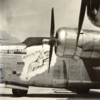
The 8th USAAF had 11 Tiger Moths loaned by the RAF and generally used as Hacks or light communication aircraft. Most were given to Fighter Groups and the HQ flight at Bovingdon. All but two had gone back to the RAF by the end of 1944. This aircraft is number DE-745 and was attached to the 353rd FG based at Raydon.

Tiger Moth in the foreground and P-38's.

Staff-Sergeant Walter Behm of the 4th Fighter Group watches an airman in the cockpit of a Tiger Moth (serial number DE-262). Image via James Gibson. Handwritten caption on reverse; 'Feb 28- Mar 12-44. S/Sgt Walter Behm, CC checks out a 335 Pilot in Sqdn Tiger Moth.'

Glenn E. Duncan, on the left, and John B. Rose Jr. of the 353rd Fighter Group, stand beside the group's de Havilland DH 82 Tiger Moth DE745 'Dorothy', which Duncan had just crash-landed into the field. 1943-1944. This is one of a series of photos taken before the above mentioned accident on 7th September 1943 at Westleton, Suffolk. Major Duncan, with Lt. Rose as passenger, landed at the crash landing of a 351st Fighter Squadron P-47 Thunderbolt piloted by Lt. Vernon A. Leatherman (a/c YJ-N 41-6585). On attempting to take off and return to Metfield, Major Duncan hit a hedge and flipped the Tiger Moth onto its back. Major Duncan and Lt. Rose were unhurt.

DH.82A Tiger Moths in service with the USAAF in Australia during WW2.
Below:
An American P-39 Airacobra fighter from the 67th Fighter Squadron (67th FS), which struck an American De Havilland DH.82A Tiger Moth (US designation PT-24), Magenta Airfield, New Caledonia, January 4, 1943.




 Login
Login Register
 FAQ
FAQ Search