Warbird Information Exchange

DISCLAIMER: The views expressed on this site are the responsibility of the poster and do not reflect the views of the management.
It is currently Sun Dec 21, 2025 3:34 pm

All times are UTC - 5 hours


Classic Wings Magazine WWII Naval Aviation Research Pacific Luftwaffe Resource Center
When Hollywood Ruled The Skies - Volumes 1 through 4 by Bruce Oriss


Post new topic Reply to topic  [ 81 posts ]  Go to page Previous  1, 2, 3, 4, 5, 6  Next
Author Message
PostPosted: Wed Feb 24, 2010 8:19 pm 
Offline
User avatar

Joined: Thu Apr 14, 2005 11:19 am
Posts: 800
Location: Vancouver BC
hey Ryan

here's a start, a pic of Churchill in the back of a Storch:

http://users.skynet.be/BAMRS/Fiesler/fi156/storch21.jpg

from this site:

http://users.skynet.be/BAMRS/Fiesler/fi-156-en.htm


And it seems that Eisenhower also flew in a Storch: (see page 3)

http://www.smds.ws/downloads/instructio ... 48006D.pdf


cheers!

greg v.


Last edited by gregv on Wed Feb 24, 2010 8:26 pm, edited 1 time in total.

Top
 Profile  
 
PostPosted: Wed Feb 24, 2010 8:26 pm 
Offline
Long Time Member
Long Time Member
User avatar

Joined: Tue May 11, 2004 5:42 pm
Posts: 6884
Location: The Goldfields, Victoria, Australia
RyanShort1 wrote:
"2. Name the type that at least four national leaders (from Axis and Allied sides) flew in (note that some of the leaders weren't leaders at the time of their flight/s - extra points)."

Quote:
Fiesler Storch maybe? I know Mussolini flew in one, not sure if old Adolph ever got a ride in one but you'd have to think maybe, as well as perhaps De Gaulle?. Did Ike ever fly in one? Churchill?

greg v.

I'd have to do some more research to be sure on this, but I think the Storch may indeed be able to claim that. The L-5 might have as well - but documenting it might be a problem at this point. I guess it also depends on whether or not the top generals counted as national leaders, or guys like Goering.

For the purposes of the argument, a 'national leader' is a head of state or prime minister, president or equivalent head of the executive of their country.

FWIW, the Storch was the type I was thinking of. Certainly Churchill, Mussolini (famously) and Eisenhower (a then future President) flew in Storches. Hitler I'm pretty sure flew in one, but the interesting bit is he also turned down a flight in one to get out of Berlin at the War's end. As well as being rescued by one, Mussolini was presented with one by Germany; and interestingly, so was Stalin, and I'd love to see evidence that Stalin or Hitler flew in one. I don't know about de Gaulle, a good call, and he'd fit, but it's quite probable, so again, I'd love to hear. I suspect some Eastern European leaders would've flown in one, potentially, but I'm not even going to try and nail that down. (Incidentally, I think Goering nearly qualifies, except Hitler dismissed him as a deputy before he was able to 'lead' Germany.)

So who'd have thought that leaders of Axis Germany, Italy, and Allied Britain and the USA, as possibly Russia and France would all have flown in a two seat type?

Walrus - see: viewtopic.php?f=3&t=34929

The calibre thing has done my head in. I still think the critical criteria are compatible calibres and suitable rounds, but I don't know how you'd qualify that. Seems important to me, because having a gun with the right calibre rounds that you can't fire is a pretty critical combat issue...

Is this interesting?

Regards,

_________________
James K

"Switch on the underwater landing lights"
Emilio Largo, Thunderball.

www.VintageAeroWriter.com


Top
 Profile  
 
PostPosted: Wed Feb 24, 2010 8:38 pm 
Offline
1000+ Posts!
1000+ Posts!

Joined: Sun Apr 22, 2007 7:43 pm
Posts: 1175
Location: Marietta, GA
JDK wrote:
Mudge wrote:
JDK wrote:
5. How many types can you name that were in production on opposing sides in W.W.II?


NOW...you know me...a bit dense at times...BUT: How many types of what?

Mudge the confused :?

Types of aircraft, Mudge.;)


I can get to over 50 us types, probably another 50 between the Brits, Germans, and Japanese. After that, I can add a few Russian, Finnish, and Italian types. In the end, maybe I could name 125...

Starting with US types.

A-20
B-17, 18, 23, 24, 25, 26, 29, 32
C-45, 46, 47, 54, 69 (not gonna add the C-82 - it's a B-24. Similarly, I didn't include the A-36 or the A-24)
F2A, F4F, F4U, F6F
L-2, 3, 4, 5
P-36, 38, 39, 40, 43, 45, 47, 51, 61, 63. Not gonna count the P-70.
PBY, PB2Y, PBM, PV1, PV2,
SBD, SB2C, SB2U
TBD, TBM
PT-17, 19, 22. Again, not gonna count multiple variations of the same airframe.
BT-13, NA-64
AT-6, AT-9
Some other types that served: Lockheed Hudson. Grummn Goose. Martin Baltimore and Maryland. Do we want to admit that the Brewster SB2A existed? Did it serve, or just hold down the pavement somewhere?

How's that for a start on US produced types?


Top
 Profile  
 
PostPosted: Wed Feb 24, 2010 8:53 pm 
Offline
Long Time Member
Long Time Member
User avatar

Joined: Tue May 11, 2004 5:42 pm
Posts: 6884
Location: The Goldfields, Victoria, Australia
Sorry Kyleb, the key word is 'production'. Good work, wrong question. ;)

_________________
James K

"Switch on the underwater landing lights"
Emilio Largo, Thunderball.

www.VintageAeroWriter.com


Top
 Profile  
 
PostPosted: Wed Feb 24, 2010 9:06 pm 
Offline
1000+ Posts!
1000+ Posts!

Joined: Sun Apr 22, 2007 7:43 pm
Posts: 1175
Location: Marietta, GA
JDK wrote:
Sorry Kyleb, the key word is 'production'. Good work, wrong question. ;)


I think the question was somewhat ambiguous. It probably had to do with your funny accent. ;-)

To clarify, are you looking for the number of types that were in production on "both sides" of the war. E.G. the DC-3/ Li-2/Whatever the Japanese called it?


Top
 Profile  
 
PostPosted: Wed Feb 24, 2010 9:17 pm 
Offline
Long Time Member
Long Time Member
User avatar

Joined: Tue May 11, 2004 5:42 pm
Posts: 6884
Location: The Goldfields, Victoria, Australia
Kyleb wrote:
I think the question was somewhat ambiguous. It probably had to do with your funny accent. ;-)

Probably, everyone thinks I'm from somewhere else. Maybe they hope that. :lol:
Quote:
To clarify, are you looking for the number of types that were in production on "both sides" of the war. E.G. the DC-3/ Li-2/Whatever the Japanese called it?

Yup!

'In service' is easy - there were hundreds. 'Production', even accepting equivalent or derived types, very few.

Regards,

_________________
James K

"Switch on the underwater landing lights"
Emilio Largo, Thunderball.

www.VintageAeroWriter.com


Top
 Profile  
 
PostPosted: Wed Feb 24, 2010 9:31 pm 
Offline
User avatar

Joined: Sun Mar 18, 2007 3:17 pm
Posts: 343
Location: Between RAAF Uranquinty and RAAF Temora
I took the question to mean that JDK was looking for types that were produced on opposing sides, both during the war.

As to the calibre thing, it's fairly simple (to a firearms-tragic like me anyway). There were quite a few rounds developed from the late 19th century on (to use the new cordite - smokeless powder), and these were fairly close in calibre. The British .303 (7.7mm), the German 7.92mm, the US 30-06 (7.62mm), the Russian 7.62x54r (being 7.62mm calibre with a 54mm-long case with a rim) and plenty of others, all of which were within about a millimetre of each other in calibre. Different projectile lengths and case lengths, along with a rimmed or rimless design and different shoulder patterns meant that they were practically all incompatible with each other. The fact that several work out at .30cal/7.62mm calibre is a coincidence as they aren't compatible with one another. To confuse matters, both the US and the USSR designed new cartridges post-WW2 which kept the calibre but were quite different, being the smaller 7.62x51 Nato round and the Soviet 7.62x39 round. Not only that, but several countries had the very close 7.65mm round. Also, there were pistol and carbine rounds in similar calibres.

So there's not really such a thing as a 'compatible calibre' as different cases and projectiles made the rounds incompatible.

As an aside, for those of us who load our own ammo, one can use different 7.62mm projectiles with cases of different types. Some people use projectiles from Soviet 7.62 rounds in .303 cases and so on.

Oh yeah, Aussies don't have funny accents. Everyone else does!

Cheers,
Matt

_________________
Matt Austin - playing with warbirds since the early 80s.

See my Lee-Enfield videos at - http://www.youtube.com/user/Jollygreenslugg


Top
 Profile  
 
PostPosted: Wed Feb 24, 2010 9:55 pm 
Offline
Long Time Member
Long Time Member
User avatar

Joined: Tue May 11, 2004 5:42 pm
Posts: 6884
Location: The Goldfields, Victoria, Australia
Jollygreenslugg wrote:
Oh yeah, Aussies don't have funny accents. Everyone else does!

Just to clarify, I don't have an 'Aussie' accent. Married to a Canadian and previously resident in the UK for 30+ years, my accent is a mongrel!

So, not being a firearms tragic, so guns chambered for the British .303 were incomparable with US weapons chambered for the .30?

In the early war the Commonwealth air forces used the .303 in just about everything - all the flexibly mounted guns, all the fighter's fixed guns and all the bombers turret guns. Mainly these were the Colt Browning, but Vickers K VGO etc as well. When you add in the Army rifles and machine guns and the Navy's light weapons being all .303 as well (and correct me if I'm wrong here, but any .303 round could be fired from any of these guns) then within the Commonwealth, this was the most common 'system' (calibre / round type). Obviously the .5 grew in use throughout the war, as did cannon, mostly(?) 20mm, cannon being preferred by '45 where it could be fitted, unlike the US.

With the US aerial guns, there seems to have been a mix of .30 and .5 at the US' start of the way (and back to '39, where by the war's end the majority was .5, I presume.

Excluding lend-lease or supplied weapons from British or US stock, did anyone else use compatible chambering for US .30 or .5 weapons of their own, and .303? The Japanese certainly made British .303 round compatible guns.

Thanks to those tackling Question 4, the successful defensive battle, good points all.

And I note that question 3 -How were early war combat gliders different from late war examples in their intended employment? has been filed under 'too hard' so far... Yet there's at least one 'right' answer here...

Cheers

_________________
James K

"Switch on the underwater landing lights"
Emilio Largo, Thunderball.

www.VintageAeroWriter.com


Top
 Profile  
 
PostPosted: Wed Feb 24, 2010 10:05 pm 
Offline
3000+ Post Club
3000+ Post Club
User avatar

Joined: Sun Feb 12, 2006 9:58 pm
Posts: 3282
Location: Nelson City, Texas
Ike not only flew in a Storch, but the British gave him a captured one to visit the front in after D Day. Also just to be nit picking the Storch is a three man aircraft (in the D model anyway).


Top
 Profile  
 
PostPosted: Thu Feb 25, 2010 9:47 am 
Offline
User avatar

Joined: Mon May 11, 2009 11:36 am
Posts: 571
Location: Shalimar, FL
Of note, the Brit .303 is a rimmed cartridge and would not work or fit it's American .30 weapons. However it could be used in the Japanese Type 92 machine gun and Type 97 machine gun respectively as they were direct copies of the Lewis and Vickers MGs and is distinctly different from the 7.7x58mm Arisaka rimless cartridge used in other Japanese machine guns and rifles.

_________________
Cheers!

Lance Jones


Top
 Profile  
 
PostPosted: Thu Feb 25, 2010 2:33 pm 
Offline
User avatar

Joined: Thu Jan 03, 2008 6:36 pm
Posts: 654
Location: Scotland
Ok, here is my bash at the glider question. Probably way off beam, but here goes.
In the early war years, gliders were used for small, pinpoint strikes, hit and run, behind enemy lines. The Germans used them very succesfully at Fort Eben-Emael in 1940, and Otto Skorzeny and a small group for the rescue of Mussolini in 1943. The British also used them, perhaps most famously to try to get toops into Norway for the destruction of the heavy water plant at Telemark. All gliders and one tug crashed short of the target, and all the crews were killed in the crashes, or executed.
Later in the war, they were mainly used as mass transport for troops, although still for insertion behind enemy lines. Operations Overlord, Market-Garden, and Varsity. These were not hit and run raids, but were meant for consolidation with other forces on land. Gliders by then even carried vehicles, ordanance, and light armour, most notably by the General Aircraft Hamilcar and Me-321 Gigant.
Gliders were still used for pinpoint attacks though. Merville Battery and Pegasus Bridge are examples of this on the eve of D-Day. These however were not hit and run targets, as they were to be held until the arrival of other forces.

So James, is this way of the mark, or do I get any points? :D

_________________
If the first casualty of war is innocence, the second is sobriety - Hawkeye.
Good people do not need laws to tell them to act responsibly, while bad people will find a way around the laws - Plato.
Lies get halfway round the world before the truth has a chance to get it's pants on - Churchill
If you are going through he11 - keep going - Churchill


Top
 Profile  
 
PostPosted: Thu Feb 25, 2010 8:31 pm 
Offline
Long Time Member
Long Time Member
User avatar

Joined: Tue May 11, 2004 5:42 pm
Posts: 6884
Location: The Goldfields, Victoria, Australia
Excellent effort, and you've touched on many of the context points - but it's not the answer I was looking for (which is a very hard one I'll say, and also disputable as in the implementation, but not the concept...).

The best clue is in the wing of the early gliders - particularly the German DFS 230 and British GAL Hotspur. After the use of the DFS 230 and early British, Russian and German training in the same mode, the emphasis shifted from how these were intended to be used to how the later, heavier gliders were actually used. What was the difference?

(This is a toughie, btw.)

_________________
James K

"Switch on the underwater landing lights"
Emilio Largo, Thunderball.

www.VintageAeroWriter.com


Top
 Profile  
 
PostPosted: Thu Feb 25, 2010 10:22 pm 
Offline
User avatar

Joined: Sun Mar 18, 2007 3:17 pm
Posts: 343
Location: Between RAAF Uranquinty and RAAF Temora
Was the change in glider use one of reusability? Were the early gliders made to be used again where possible while later on they were seen as a 'one-shot' or 'disposable' machine?

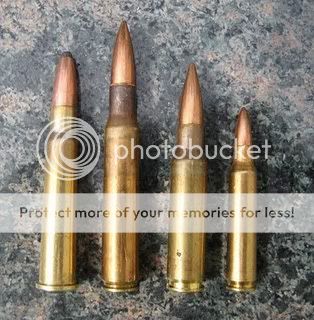
Cartridges may have the same caibre, but the shape of the case determines interchangability. The chamber (where the round 'sits' when loaded to be fired) is shaped to suit the particular round used. If the case is different, then the same calibre doesn't mean much.

As an example, here we have a picture of some of the rounds discussed earlier. (Courtesy of http://oblio13.blogspot.com/2009/09/service-rifles.html)

Image

They are; .303 British, .30-06, 7.62 x 51 NATO, and 5.56 x 45 NATO.

As can be seen, despite two of these having the same calibre, there's no way that any of these rounds will interchange.

Cheers,
Matt

_________________
Matt Austin - playing with warbirds since the early 80s.

See my Lee-Enfield videos at - http://www.youtube.com/user/Jollygreenslugg


Top
 Profile  
 
PostPosted: Thu Feb 25, 2010 10:41 pm 
Offline
Long Time Member
Long Time Member
User avatar

Joined: Tue May 11, 2004 5:42 pm
Posts: 6884
Location: The Goldfields, Victoria, Australia
Jollygreenslugg wrote:
Was the change in glider use one of reusability? Were the early gliders made to be used again where possible while later on they were seen as a 'one-shot' or 'disposable' machine?

Good idea, but no. AFAIK, all production gliders were regarded as semi-disposable, to be re-used where possible but always expecting a high attrition rate, which is pretty much what happened, except the process of recovery of the Horsa and CG-4 was more difficult and thus less often achieved than expected. That's when they started the idea of attaching engines to fly them back out, inventing something called 'the aeroplane' ~ all over again. :lol:

I've just thought of another answer that would fit the question, and has been discussed here...

The rounds question is a good one, thanks for the illustration, which shows why the British Colt Browning .303 had to be redesigned to take a different round to the US .30 gun, although it remained essentially the same weapon. I note the British round is the only rimmed example; did that have a major difference in the chamber and extraction principle? (Obviously the design differed, but could a design that worked for one be adapted, without a major change in the mechanical process, to the other?)

Regards,

_________________
James K

"Switch on the underwater landing lights"
Emilio Largo, Thunderball.

www.VintageAeroWriter.com


Top
 Profile  
 
PostPosted: Thu Feb 25, 2010 10:42 pm 
Offline
3000+ Post Club
3000+ Post Club
User avatar

Joined: Tue May 04, 2004 8:54 am
Posts: 3333
JDK wrote:
5. How many types can you name that were in production on opposing sides in W.W.II?


Please sir, can I play? :D

JB-2 Loon / V-1


Top
 Profile  
 
Display posts from previous:  Sort by  
Post new topic Reply to topic  [ 81 posts ]  Go to page Previous  1, 2, 3, 4, 5, 6  Next

All times are UTC - 5 hours


Who is online

Users browsing this forum: Google [Bot] and 94 guests


You cannot post new topics in this forum
You cannot reply to topics in this forum
You cannot edit your posts in this forum
You cannot delete your posts in this forum
You cannot post attachments in this forum

Search for:
Jump to:  
Powered by phpBB® Forum Software © phpBB Group