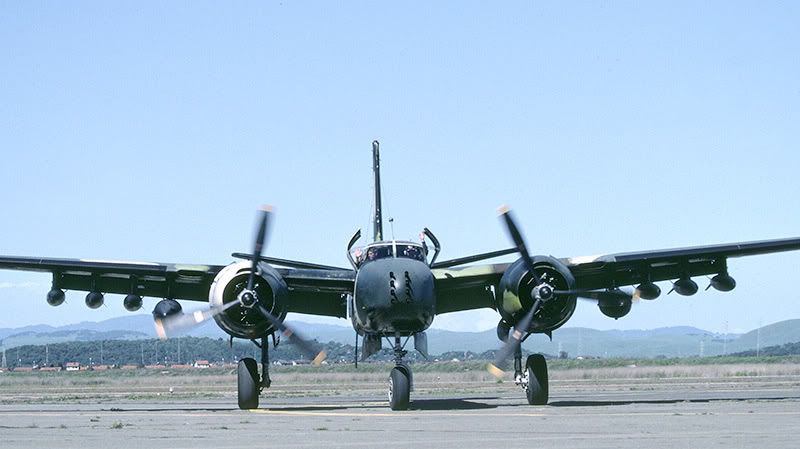
Wing corrosion AD:
http://www.airweb.faa.gov/Regulatory_an ... light=a-26
Typical aging aircraft problem I would think.
Spar cracking AD:
http://www.airweb.faa.gov/Regulatory_an ... light=a-26
Quote:
To prevent loss of wing structural integrity due to failure of a lower spar cap, accomplish the following:
A. Within ten (10) hours time in service after the effective date of this AD, perform a visual dye penetrant inspection of the lower forward and aft spar cap, outboard and inboard of each nacelle in the area where the nacelle fairing upper edge runs across the lower spar cap surface. Trim the fairing edge if necessary, to ensure that the fairing edge is smooth and that there is a minimum of one-sixteenth inch (1/16") clearance between the fairing and spar cap surface.
B. If no cracking or fretting of the spar cap is detected, repeat the inspection for cracks, surface clearance, and condition in accordance with Paragraph A. of this AD at intervals not to exceed 500 hours time in service.
C. If any evidence of cracking or fretting is found in the spar caps, polish out to a machine finish not to exceed approximately 125 microinches on both sides of the damaged area to a maximum depth of 0.030 inches and repeat the inspection of Paragraph A., above. Continue to inspect in accordance with Paragraph A. at intervals not to exceed 30 hours time in service.
D. If cracking or fretting in excess of 0.030 inches in a spar cap is detected, repair in a manner approved by the Manager, Western Aircraft Certification Office, FAA, Northwest Mountain Region, Hawthorne, California.
E. For those aircraft which have been modified to incorporate a steel or titanium lower front spar cap strap (in the area where the nacelle fairing upper edge is in contact with the lower wing surface) in accordance with AD 64-12-03, the requirements of Paragraph A. of this AD are applicable only to the lower aft spar cap, outboard and inboard of each nacelle.
F. Within 72 hours after performing the inspections required by Paragraph A., above, report the results of the inspections to the Manager, Western Aircraft Certification Office, ANM-170W, FAA, Northwest Mountain Region, 15000 Aviation Blvd., Hawthorne, California. Mailing address: P.O. Box 92007, Worldway Postal Center, Los Angeles, California 90009. The reports should cite the airplane registration and serial number, crack location and extent of damage, total airplane operating hours, and time since last inspection.
G. Special flight permits may be issued in accordance with FAR 21.197 and 21.199 to operate airplanes to a base for the accomplishment of inspections required by this AD.
H. Alternate inspections, modifications, or other actions which provide an acceptable level of safety may be used when approved by the Manager, Western Aircraft Certification Office, FAA, Northwest Mountain Region, Hawthorne, California.
This amendment becomes effective April 16, 1985, and it was effective earlier to all recipients of priority mail AD 84-15-02, issued August 1, 1984.
That is basically a design flaw (on an aircraft never expected to be in service for so long).
INSERT SOAPBOX:
There is no connection between a high wing loading and structural fatigue.
Wing loading is the wing area divided by the weight of the aircraft. Aircraft with high wing loading tend to have shorter wings which reduces bending moment on the wings. Support yourself on some parallel bars at your elbows with your arms straight out. Then try again with wider parallel bars supporting yourself at your wrists. It is much harder with longer "wings."
Metal fatigue is dependant on:
a) Stress (force/cross sectional area or pounds per square inch) which is a function of the design and the flight conditions which result in loads
b) Load cycles (vibration)- typically gust loads on larger aircraft or how many times you perform an aerobatic maneuver
Fatigue curves plot stress vs. cycles to failure. A low stress level takes many more cycles to accumulate the same damage as a high stress level would.

Airliners and transports have very low G-load limits. Fatigue damage is usually accumulated due to gust loads (turbulence) over a long period of time or in the case of pressurized aircraft, the number of pressure cycles on the fuselage. Large aircraft on the receiving end of aerial refueling accumulate fatigue damage very quickly. So do fire bombers which operate in a low level (dense air) gusty environment.
The fatigue failures on the ACM T-34 fleet were caused by only a few cycles of excessive load (over-G). If you look at the "Yield strength" line (about 100,000 psi nominal stress) on the graph, that is where the metal deforms (bends) permanently. Between 100 and 1000 cycles the yield strength line intersects the curve. If you operate at that (over) stress level you can see it doesn't take many cycles over 50 years to result in a fatigue failure. Add corrosion and other damage to the mix and you are operating on borrowed time. Operate that same aircraft with a stress level of 75,000 psi and you can do that maneuver 10,000 times.


 Login
Login Register
 FAQ
FAQ Search








 This maybe the other one as far as being released by the military anybody know the facts?